
My neighbor repainted her house last spring. Dark navy siding, white trim — she’d been planning it for two years, saved up, hired a good crew.
The job took four days. By day three, standing on the sidewalk looking at it, she knew it was wrong.
Too dark for the lot, too stark against the stone walkway, nothing like the image she’d had in her head.
She repainted six weeks later. Different color, different contractor, same house. The whole episode cost her around $9,000.
The thing is, this is completely preventable. Not with better taste or more Pinterest browsing — with a 3D render of your actual home, in the actual color, sitting on your actual street.
That technology exists, it’s more accessible than most people realize, and it’s exactly the kind of tool that should be used before any significant exterior project.
Here’s what it involves, where it’s most useful, and how to get it done without hiring an architect.
The Exterior Commitment Problem
Interior changes are reversible, at least in theory. Paint over it. Reupholster. Swap the rug. Exterior changes are a different category entirely.
Siding, roofing, hardscaping, landscaping — these are multi-year commitments that your whole neighborhood gets to see every single day.
The standard tools for previewing exterior changes are terrible. Paint chips look nothing like paint at full scale on real siding.
Landscape design sketches require you to mentally transform a 2D drawing into a finished garden.
Contractor mockups, when you get them at all, are often simple elevations that flatten everything and strip out the context that makes or breaks a design.
The gap between ‘I think this will look good’ and ‘I can see that this looks good’ is where expensive mistakes live. A 3D exterior render closes that gap.
What a 3D Exterior Render Actually Shows You
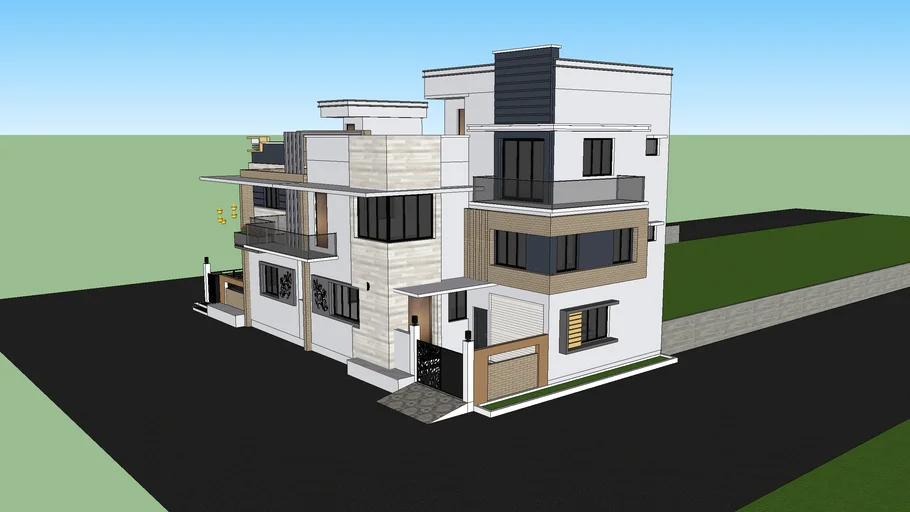
Professional 3d exterior visualization services produce photorealistic images of your home’s exterior — built from your actual dimensions, your specific material choices, and your real site context.
The output looks like a photograph of a finished house. The house just doesn’t exist yet.
For homeowners, the practically useful outputs include:
• Façade color and material changes. Your exact house, your exact roofline and trim, in the new siding color.
Not a generic colonial in navy — your colonial, your lot, your trees in the background. The difference in useful information is enormous.
• Window and door replacements. New windows change the feel of an exterior dramatically.
A render lets you compare black-frame casements versus white double-hungs on your specific home before the order is placed and the installation crew shows up.
• Additions and structural changes. Garage conversion, front porch addition, second-story bump-out — changes that alter the roofline and massing of a house are the hardest to visualize mentally.
Seeing the addition rendered at scale against the existing structure tells you things a floor plan simply cannot.
• Driveway, pathways, and hardscaping. Whether it’s a new driveway material, a front walkway redesign, or a retaining wall, these elements interact with the house and each other in ways that only become clear when you can see the whole picture.
The Landscaping Variable Nobody Plans For
Here’s the thing about exterior makeovers that most homeowners underestimate: the landscaping is doing half the work, and it changes everything.
A house with the right plantings, a clean lawn edge, and some defined garden beds can look like a completely different property from the same house with an overgrown foundation and a bare front strip.
Conversely, a beautifully landscaped yard can make a dated exterior look charming. These elements don’t exist independently — they interact.
This is where landscape architecture rendering becomes genuinely useful for residential projects.
A landscape render shows you the finished yard — not just a planting plan, but mature plantings in their actual positions, seasonal context, how the garden relates to the driveway and the house front, where the eye goes when you stand at the street.
Plants take years to establish. A render shows you year-five, not year-one.
That matters when you’re deciding whether the Japanese maple in the front corner is going to work at scale, or whether it’s going to block the window and crowd the path when it matures.
Seeing the landscaping and the house exterior together — rather than making those decisions separately and hoping they work — is how you end up with a cohesive result rather than a front yard that looks like several good ideas that never quite talked to each other.
Seasonal and Lighting Renders: The Detail That Changes Decisions
One thing that surprises people who haven’t used 3D exterior visualization before: you can see the same design in multiple lighting conditions and seasons.
Same house, same paint, same plantings — but here it is in July afternoon sun, here it is on an overcast November day, here it is at dusk with the porch light on.
This matters more than it sounds. A dark gray siding that looks sophisticated and moody in bright summer light can read as flat and depressing in the gray light of a Northeast winter.
A warm white that glows beautifully in afternoon sun can look dingy by morning.
These are the things paint chips at the hardware store will never show you — and they’re the things that determine whether you actually like looking at your house nine months of the year.
Similarly, north-facing and south-facing houses read very differently in the same color because of how light falls on them.
A render built with your home’s actual orientation accounts for that. A paint chip does not.
How to Actually Get This Done
There are a few routes depending on what you need and what you want to spend:
1. Free and low-cost apps. Tools like iScape (landscaping), Houzz, and some paint company apps (Benjamin Moore, Sherwin-Williams) let you upload a photo of your home and swap colors or add elements.
These work well for a quick color check. They don’t work well for structural changes, complex landscaping, or anything requiring accurate scale.
2. Work with your contractor. Many good landscapers and exterior renovation contractors now offer basic 3D visualization as part of their proposal process.
If yours doesn’t, ask — it’s worth requesting before you sign anything.
3. Commission a professional render. For significant projects — full exterior renovation, major landscaping overhaul, addition — a professional 3D studio produces results that free tools cannot match.
You get your actual house, accurate materials, real site context, multiple angles, day and dusk versions. Costs vary by scope but typically run $300–$800 for a residential exterior package.
Against the cost of a $20,000 landscaping project or a $15,000 siding job, that’s a small premium for certainty.
What to Prepare Before You Start
Whether you’re using an app or hiring a studio, the more specific information you provide, the more useful the result. Before you start:
• Take photos of your exterior from the street, from both corners, and straight-on — on a bright day without strong shadows if possible
• Note which direction your home faces — this affects how light renders
• Collect the specific materials you’re considering, including manufacturer names and finish/color codes
• Identify what’s staying — roof color, driveway material, any mature trees or permanent plantings that aren’t changing
• Find reference images of finished homes you like, even roughly — these communicate style intent faster than descriptions
A rough site sketch showing your property boundaries, the house footprint, and any major existing features (big trees, slope, fence lines) is helpful if you’re doing landscaping work.
You don’t need an official survey — a hand-drawn approximation is fine to start.
The Real Value: Confidence Before the Crane
There’s a version of exterior renovating that goes: pick a color, trust your gut, close your eyes, write the check.
Sometimes it works out. Often enough that it doesn’t, people end up in my neighbor’s situation — staring at their house from the sidewalk thinking about how much the repaint is going to cost.
3D visualization doesn’t replace good taste or good contractors.
What it does is let you make decisions with your eyes open — seeing the finished result before any money is spent, any plants are planted, any paint is ordered.
For the scale of investment that exterior projects represent, that’s not a luxury. It’s just the smart way to do it.
The tools are there. Might as well use them.