

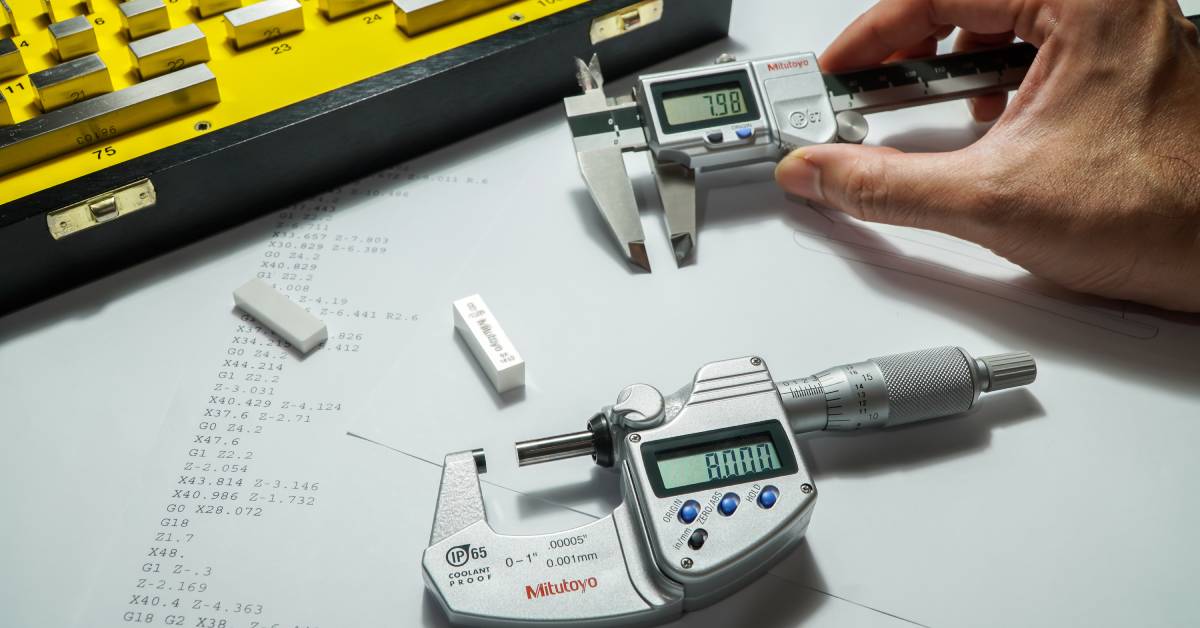
Accurate measurement is essential in any CNC machine shop, fabrication environment, or quality control department.
Even minor dimensional errors can affect part fit, surface finish, and overall performance.
Among the most commonly used inspection tools are calipers, which provide fast and reliable measurements for outside, inside, and depth dimensions.
When selecting a caliper, machinists often face a common question: should you choose digital or dial? Both tools serve the same core purpose, but they differ in display style, functionality, durability, and user preference.
This guide breaks down the key differences between digital and dial calipers and explains how to choose the right option for precision measurement.
Key Differences Between Digital and Dial Calipers
Calipers are versatile measuring tools used for quick and accurate dimensional checks.
The main difference between digital and dial calipers lies in how the measurement is displayed and how readings are interpreted.
A digital caliper provides measurements on an electronic display.
Readings are shown numerically, eliminating the need to interpret a scale manually.
Digital models often allow users to switch between inch and metric units instantly, making them ideal for shops that work with multiple measurement systems.
Advantages of digital calipers include:
- Easy-to-read numeric display
- Quick unit conversion (inch/mm)
- Zeroing capability at any position
- Reduced chance of misreading
However, digital calipers require batteries and may be more sensitive to coolant or harsh shop environments if not properly sealed.
Dial calipers, on the other hand, use a mechanical dial face combined with a linear scale.
The needle on the dial rotates to indicate fractional measurements, while the beam scale displays whole numbers. Many machinists appreciate dial calipers for their durability and mechanical reliability.
Benefits of dial calipers include:
- No batteries required
- Durable mechanical operation
- Clear visual reference of movement
- Reliable performance in rugged conditions
Both digital and dial calipers can provide excellent accuracy when properly calibrated and maintained. The choice often depends on user preference and specific shop conditions.
While calipers are highly versatile, they are not the only tools required for precision inspection.
For setup alignment and fine adjustment verification, dial indicators are commonly used.
These tools help machinists check runout, flatness, and alignment during machine setup, ensuring parts are positioned correctly before cutting begins.
For tighter tolerances beyond the resolution of standard calipers, micrometers provide greater measurement precision.
Micrometers are often used to measure outside diameters, thicknesses, and critical features where thousandths—or even tenths—of an inch matter.
Choosing the Right Caliper for Precision Measurement
Selecting the right caliper depends on your workflow, tolerance requirements, and working environment.
Consider Your Tolerance Range
If your applications require general measurements with moderate tolerances, both digital and dial calipers will perform well. However, if you frequently work with multiple unit systems, a digital caliper offers convenience through quick conversion.
Evaluate Shop Conditions
In environments with heavy coolant exposure or frequent temperature changes, mechanical dial calipers may offer greater durability. Digital calipers should be properly maintained to protect electronic components.
Think About Ease of Use
Digital displays reduce interpretation errors, which can be beneficial for new operators.
Dial calipers require familiarity with reading the dial and beam scale but provide strong visual feedback on movement and incremental changes.
Pair with Complementary Tools
Calipers are excellent for quick dimensional checks, but they are not designed for ultra-tight tolerances. For high-precision work, supplement calipers with micrometers and dial indicators.
This layered inspection approach ensures that both setup and final measurements meet specification.
Prioritize Calibration
Regardless of type, all calipers must be calibrated regularly. Even small deviations in measurement tools can compromise part quality over time.
Building a Reliable Measurement Strategy
A strong inspection process combines the right tools with consistent procedures.
Digital calipers provide fast, readable results. Dial calipers offer mechanical reliability and durability. Dial indicators support alignment and setup verification. Micrometers deliver enhanced precision for critical dimensions.
Rather than choosing one tool to handle every measurement, professional shops integrate multiple instruments into their quality control workflow.
This ensures that each measurement task is handled by the most appropriate tool.
By understanding the strengths and limitations of each device, machinists can reduce error, improve repeatability, and maintain tighter tolerances.
Conclusion
Digital and dial calipers both play important roles in accurate measurement.
A digital caliper offers convenience and easy readability, while dial models provide dependable mechanical performance.
For setup accuracy, dial indicators help verify alignment and minimize runout.
When tolerances demand greater precision, micrometers deliver the accuracy required for critical dimensions.
Choosing the right caliper ultimately depends on your application, environment, and personal preference.
By combining the proper measuring tools with disciplined inspection practices, machine shops can achieve consistent, high-accuracy results across every production run.