
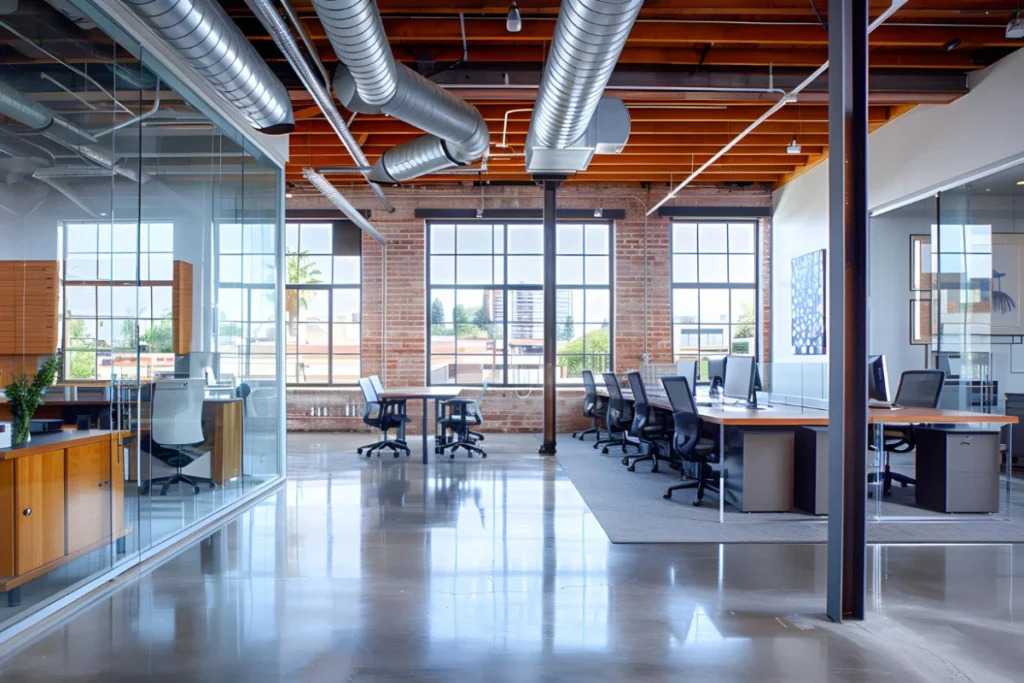
The way technology companies design their workspaces says a lot about how they think, hire, and build products.
Over the past two years, tech office interior design has moved away from the ping-pong-table-and-beanbag era toward something grounded in employee research and tied to measurable outcomes.
Whether a startup is about to rent office space for the first time or a scaling company is rethinking its headquarters, the physical environment now carries strategic weight.
Acoustic Engineering Has Replaced Open-Plan Worship
For over a decade, open floor plans dominated modern tech office layouts.
Fewer walls meant more collaboration, or so the logic went. But poor acoustics remains the number-one workplace complaint according to multiple industry surveys, and hybrid meetings made the problem worse.
How Designers Are Responding
By 2025 and into 2026, designers began treating sound as an architectural material.
Timber-look acoustic grids, felt ceiling systems, and ribbed glass partitions now appear in nearly every commercial interior concept targeting tech tenants.
Gensler’s 2025 Global Workplace Survey confirmed that technology has become a driving force in workspace planning, and that includes systems designed to control noise in real time.
What It Looks Like on the Ground
- Conference rooms with embedded sound-masking systems
- Phone booths and pods placed at regular intervals across floors
- Carpet tiles engineered for sound absorption under collaborative zones, paired with hard surfaces in transit corridors
The futuristic office design people imagined ten years ago turned out to be quiet, not loud.
Biophilic Design at Production Scale
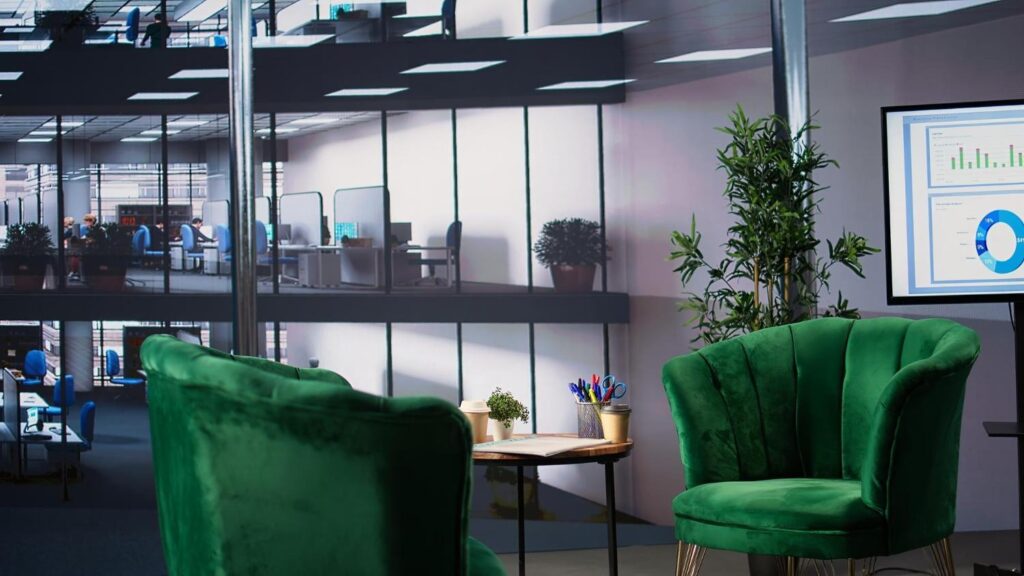
Living plant walls, reclaimed wood surfaces, water features, and organic color palettes are no longer reserved for reception lobbies. In technology office design, they now appear in workstation clusters, meeting rooms, and common areas adjacent to server rooms.
The Numbers Behind the Green
Research from the Human Spaces global study:
- Workers in environments with natural elements reported 6% higher productivity
- 15% higher creativity in biophilic office settings
- Employee wellbeing scores increased by 15% in green-enriched workspaces
Where Materials Are Heading
Tech companies have taken these findings seriously. Interior teams now integrate moss walls that double as acoustic panels and daylight-responsive window treatments that adjust tint based on sun angle. Bamboo, reclaimed timber, and low-VOC paints are standard procurement items, not premium upgrades.
Hospitality-Influenced Spaces Are Pulling People Back
With over 28% of working adults in Great Britain hybrid working between January and March 2025 (and similar or higher rates across the US tech sector), the office needs a reason to exist beyond obligation.
The answer many tech office interior design teams have landed on borrows from hotels, cafes, and members’ clubs.
What Hospitality Borrowing Looks Like
- Reception areas styled as boutique hotel lobbies
- Breakout spaces with layered textures, softer lighting, and residential-style furniture
- Cafe-style zones with barista-quality coffee stations for informal interaction that Slack channels cannot replicate
The point is not to turn offices into lounges. When companies invest in sensory quality (scent, temperature, visual warmth), attendance tends to stabilize without mandates.
Penketh Interiors noted in their 2026 trends report that some companies now commission bespoke aromas as part of their brand identity within the workspace. For modern tech office environments, the competition is no longer other offices; it is the comfort of home.
Micro-Zoning Replaces the One-Size-Fits-All Floor
The single continuous open plan is dissolving. Futuristic office design thinking now treats each floor as a collection of distinct micro-zones, each tuned to a specific type of work.
| Zone Type | Purpose | Typical Features |
| Focus pods | Deep individual work | Low stimulation, controlled acoustics, minimal visual clutter |
| Social hubs | Informal collaboration | Lounge seating, warm lighting, cafe amenities |
| Team rooms | Structured group work | Writable walls, AV integration, flexible furniture |
| Wellness corners | Mental reset | Dim lighting, meditation pads, air purification |
| Touchdown desks | Hot-desking for hybrid workers | Power access, storage lockers, bookable via app |
Why Zoning Matters for Wellbeing
Aflac’s 2025 workforce report found that nearly 3 in 4 U.S. workers experience moderate to very high stress at work.
Micro-zoning gives employees autonomy over their sensory environment, and research shows that perceived environmental choice lowers stress hormones while raising intrinsic motivation.
For technology office design teams, there is also a practical benefit: modular zones reconfigure without construction as headcounts shift with project cycles.
A team that grows from eight to twenty people over a quarter does not need a renovation; it needs moveable walls and reconfigurable pod clusters.
Invisible Tech Integration Is the New Standard
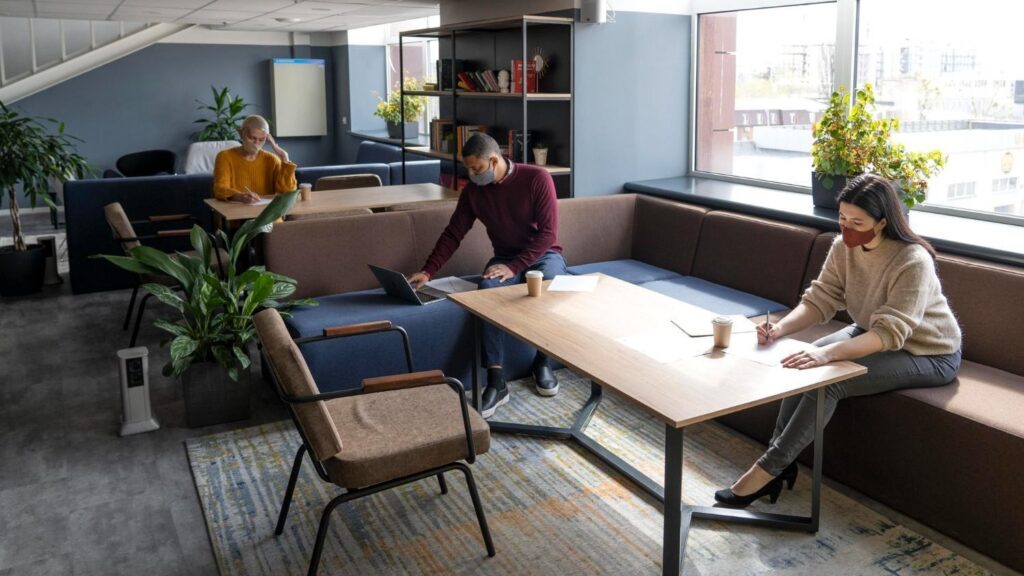
The visible technology era (cables across desks, ceiling-mounted projectors, tangled docking stations) is ending. In the modern tech office of 2026, technology is present but hidden.
Where the Hardware Disappears To
- Wireless charging pads built into desk surfaces
- USB-C ports recessed into conference tables
- Occupancy sensors embedded in ceiling fixtures, feeding data to building management systems
- Smart lighting that adjusts color temperature based on time of day and room usage
IoT-connected furniture has entered the mainstream, too.
Desks with built-in sensors track usage patterns and feed data to facilities teams for floor plan optimization. Sensor-enabled chairs monitor posture and prompt micro-adjustments.
The best tech office interior design implementations feel analog and warm on the surface while running complex systems underneath, keeping the workspace human rather than clinical.
Sustainability as Operational Infrastructure, Not a Badge
Sustainability in technology office design has moved past the brochure stage. Recycled materials, energy-efficient HVAC, and low-emission finishes are baseline procurement standards for most commercial fitouts.
The 2026 Shift: Life-Cycle Thinking
The real change is modular, life-cycle-oriented design:
- Furniture that can be disassembled, moved, and reconfigured without waste
- Acoustic pods built as reusable architecture rather than fixed construction
- Modular elements that extend the life of existing spaces and lower embodied carbon
One study of small and medium enterprises found that companies with genuine sustainability commitments delivered stronger financial performance during economic uncertainty.
For tech companies competing for environmentally conscious talent, the office becomes a proof point.
Where Quiet Confidence Meets Smart Floors
The tech office of 2026 does not try to impress with spectacle.
It impresses through considered detail: the acoustic tile that absorbs just enough noise, the plant wall that cleans the air, the furniture that reconfigures in minutes when a team doubles in size.
Spaces like these work because they were designed around how people behave, not how designers wish they would.