

In the present-day civilization, electricity is the blood, and it runs all of our lives, including the lamps in our houses and the huge machines that run our factories.
The increased dependence on electricity bill also increases the number of professional people who are able to install, maintain, and repair those complicated systems.
Being an electrician is a good career choice for those who want a stable, well-paid, and intellectually stimulating career.
Nevertheless, the road to becoming a beginner and becoming a licensed professional cannot be shortened. It demands a combination of both intensive academic work and practical experience.
The first thing one needs when joining this vibrant trade is to understand its structure in the case of electrician training programs.

The Foundation of Your Career: Choosing the Right Educational Path
The path to becoming an electrician is usually marked by a good educational background.
Although one can begin the field by receiving on-the-job training, the number of successful electricians who began with a formal training program is overwhelming.
Such programs are aimed at teaching students theoretical skills on how to comprehend the functioning of electrical systems.
The next step of choice is usually attending a good tech school or community college where there is an organized environment where safety measures and electrical theory are outlined.
Since the licensing regulations and curriculum standards may differ greatly according to the place where you are going to work, many future students can find it helpful to search electrician schools by state to make sure that the program prepared meets the local requirements.
The study assists candidates in determining which schools provide the desired credit hours and certifications that are needed by the state licensing board.
Regardless of selecting a certificate course that spans over months or an associate degree that spans two years, the aim at this first stage is to ensure that the student is ready to take the demands of an apprenticeship and a state licensure exam.
Classroom Instruction: The Theory Behind the Trade
The student should be aware of the invisible forces before he or she touches a live wire.
Classroom teaching is an important part of any training program for electricians.
This is the place where students get to know the math and physics that are necessary in the trade.
Electrical theory, Ohm’s law, and series and parallel circuit properties are usually taught.
An electrician can only be guessing without this theoretical understanding, and this is potentially dangerous.
The National Electrical Code (NEC) takes up a significant part of the classroom program.
The NEC is sometimes simply known as the Code, and the NEC is the standard of safe electrical design, installation, and inspection in the United States.
Students also know how to move around in this huge volume, decipher complicated language, and understand that all installations have standards of legal safety. Students in the classroom must learn blueprint reading as one of their essential skills.
The ability to read architectural drawings and schematics enables electricians to determine the placement of outlets, switches, and fixtures.
Hands-On Training and Lab Work
Although theory gives the why, practical training gives the how.
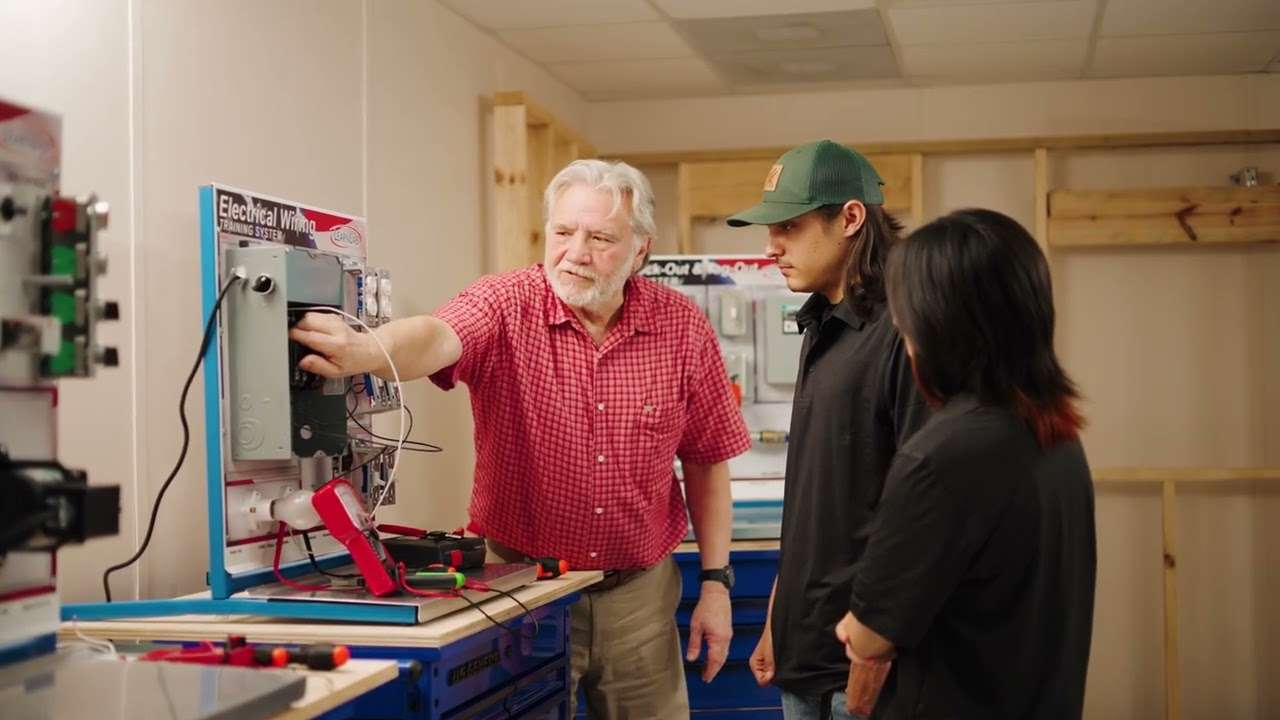
In most of the quality programs, a lot of lab work would be involved, and the students would be able to use their classroom knowledge in a controlled setting.
These laboratories are able to mimic real-life processes and students can train to bend conduit, pull wire, and tie circuits with reduced risk of harm should an accident occur, as in a live construction site.
Students would be introduced to instruments of the trade in the lab.
They are taught on how to use multimeters to measure voltage, current, and resistance, and how to make good use of wire strippers, fish tape,s and the use of power tools. The most important aspect in this stage is safety.
They are drilled with Occupational Safety and Health Administration (OSHA) standards, in which they learn how to lock when working with electrical systems and tag out in order to avoid accidental energization.
This experience of mastery of the tools and safety awareness creates the confidence required to move into an actual working environment.
Apprenticeships: Bridging the Gap Between School and Work
Leaving one of the training programs is a big step, and the educational process just started.
The second, and what can be considered the most important, is the apprenticeship.
The apprenticeship programs have been termed as the earn as you learn programs.
They combine practical work experience with actual electrical training through both on-the-job experience and classroom instruction.
Union organizations such as the International Brotherhood of Electrical Workers (IBEW) and non-union contractor associations like the Associated Builders and Contractors (ABC) sponsor apprenticeship programs.
As the apprentice undergoes the apprenticeship period, which takes between four and five years, more elaborate tasks will be done.
- Year 1-2: simple jobs such as hole drilling, anchoring, and retrieving of implements. The apprentice is more of a spectator and a servant.
- Year 3-4: Attaching wire, installation of receptacles and switches and connecting simple circuits with close guidance.
- Year 5: Gradual troubleshooting of systems, installation of motors, and almost all duties of a Journeyman, awaiting final examination.
The reason behind this required apprenticeship time is that it introduces the trainees into the vagaries of a real-life construction site, weather conditions, and issue-solving situations that are not duplicated in a laboratory.
Licensure and Certification: The Final Hurdle
Among the most significant differences in the electrical trade is the fact that the profession is one of the most regulated.
Also, unlike some other trades, electricians are almost obligated to be licensed by almost every state.
The particular conditions depend, but typically, once a candidate is done with an apprenticeship and has met the necessary hours (the benchmark being approximately 8 000 hours of on-the-job training), he or she becomes eligible to pass the Journeyman electrician exam.
This exam is on knowledge of NEC, local electrical codes, and general electrical theory.
A successful examination following this exam gives the person the designation of Journeyman Electrician and they can work on their own without supervision.
Further on down the line, the electricians demonstrate the choice of becoming Master Electricians that comes with a more complicated test and the capability of the issuance of the permits to the large-scale projects and supervising of other electricians.
These licenses are frequently subject to continuous education so that electricians can keep up with the changes of the Code and the latest technologies, such as solar integration and smart home systems.
Specialization Opportunities
Electrical work is a large field, and training programs tend to border on different specializations.
Although general electricians can do most residential and commercial wiring, the industry has niches that demand special expertise:
- Residential Electricians: Specialize in installing outlets, lighting, circuit breakers and wiring of homes. They have to work with standard voltage (120 V / 240 V).
- Commercial Electricians: Operate in offices, shopping areas, and hospitals. They usually work with greater voltage, compound fire alarm systems, and backup generators.
- Industrial Electricians: They work in factories and plants. They hold huge motors, conveyor belts, and complicated production line machinery.
- Linemen: They work with utility companies and install and maintain the power lines that carry electricity between the power stations and the substations, and the end-users.
Journey to the classroom to the jobsite is a process of reinventing, where a beginner student becomes a highly skilled tradesperson.
It involves commitment to the study and work, safety, and ongoing education.
The rewards can be huge, which is a financially stable and fulfilling career, for those who are ready to pay enough effort.
To give yourself the best jump into this competitive industry, it is always good to take time, do research and compare electrician schools by state.
That way, you will be able to find a program that will suit your needs and put you on the road to licensure.
You are either starting now, or you want to change your career.
The most important thing is to know the layout of these training programs, and this will open the door to a great future in the electrical industry.
Frequently Asked Questions (FAQs)
The time is flexible, though as a rule, it is around 1- 2 years of classroom training and 4-5 years of an apprenticeship. All in all, most individuals are fully licensed Journeyman electricians in a duration of 5 to 7 years after beginning their education.
No, there is no requirement of a 4-year college degree. The entry into the field is most frequently done using a certificate program by a trade school or a community college, or straight into an apprenticeship program. Nonetheless, good experience in math (algebra and trigonometry) is of great use.
Yes, it is possible that the trade may be physical. It is characterized by working long hours standing on ladders, heavy lifting, and in restricted areas or heights. Nonetheless, such demands can be addressed by means of physical fitness and appropriate safety methods.