

A well-finished tiled floor looks effortless, but the decisions behind it rarely are.
Most attention goes to colour, size and layout. The less visible components tend to be an afterthought.
Yet the choice of floor tile adhesive often determines whether that surface holds firm or begins to sound hollow months later.
Adhesive must suit the tile, the base beneath it and the conditions the space will face.
Get that alignment right, and the rest of the installation has a fair chance of lasting.
Why Choosing the Right Adhesive Is Important
Tiles are not uniform blocks of ceramic. Porcelain is dense and barely absorbs moisture, which makes bonding more demanding.
It needs an adhesive capable of forming a strong mechanical grip rather than relying on absorption. Natural stone behaves differently again.
Marble and travertine can shift slightly and may react to excess moisture, so flexibility and controlled curing become important.
The surface underneath plays its part as well. A concrete slab, fiber cement sheet or an existing tiled floor all present different bonding challenges.
Add moisture from bathrooms remodeling, laundries or entry areas during wet weather and the equation changes again.
Choosing without weighing these factors invites trouble. Lifting corners, cracked grout lines and patchy curing are rarely random events.
They usually trace back to a mismatch at the bonding layer.
Looking Closely At Tile Composition And Size
Before opening a bag of adhesive, study the tile itself.
Large format pieces, now common in contemporary interiors, place greater stress on the bond.
Their size leaves little margin for uneven coverage. An adhesive with strong initial grab and low slump helps keep them steady while they set.
Weight should also be considered. Thicker or heavier tiles often need a deeper adhesive bed to ensure full support across the back.
Skimp on coverage and you risk voids beneath the surface. Those gaps may not show immediately, but foot traffic has a way of revealing weaknesses.
Stone introduces its own quirks. Some varieties are prone to staining if moisture migrates through the adhesive.
Selecting a formulation suited to stone reduces that risk. Installations over heated floors raise another consideration.
Temperature changes cause expansion and contraction, so a flexible adhesive helps the system move without distress.
Choosing An Adhesive That Fits The Environment
Cement-based adhesives remain a staple for floor work due to their strength and reliability.
Many projects, however, benefit from polymer-modified options that offer added flexibility and improved adhesion.
They perform well where minor movement or heavier loads are expected.
In dry, stable interior rooms, a standard grade product may suffice.
Contrast that with retail spaces, hallways or areas exposed to water, where higher performance specifications are prudent.
Paying attention to technical data sheets might not be glamorous, yet it clarifies whether the adhesive is rated for the substrate and conditions at hand.
Practical details deserve attention as well. Open time influences how much area can be spread before tiles must be laid.
Curing time affects scheduling and when the floor can accept traffic. Coverage rates determine how much product to order and can impact overall cost.
These small calculations often separate smooth projects from drawn out ones.
Installation Techniques That Safeguard Longevity
Even the most suitable adhesive cannot compensate for careless preparation.
Substrates should be clean, sound and level before work begins. Mixing must follow manufacturer guidance, with water ratios measured rather than guessed.
Consistency in the mix supports consistent performance on the floor.
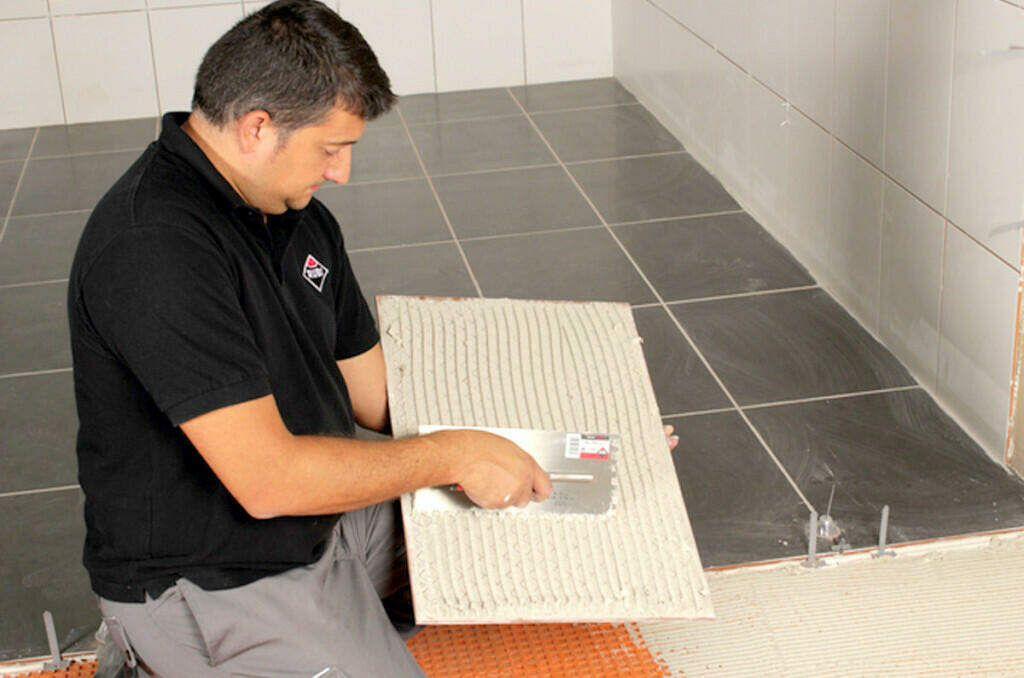
Application technique also counts. Using the correct notched trowel helps achieve adequate coverage.
For larger tiles, back buttering can improve contact and reduce voids. Pressing tiles firmly into place and checking occasionally by lifting one to inspect coverage is time well spent.
Environmental conditions influence outcomes more than many expect. Extreme heat can shorten working time.
Cold slows curing. Allowing sufficient time before grouting or loading the surface protects the bond while it develops strength.
Final Thoughts
When adhesive, tile and site conditions are considered together, the result is a flooring system that performs as intended.
Thoughtful planning at this stage spares frustration later and keeps the finished surface looking as solid as the day it was laid.