

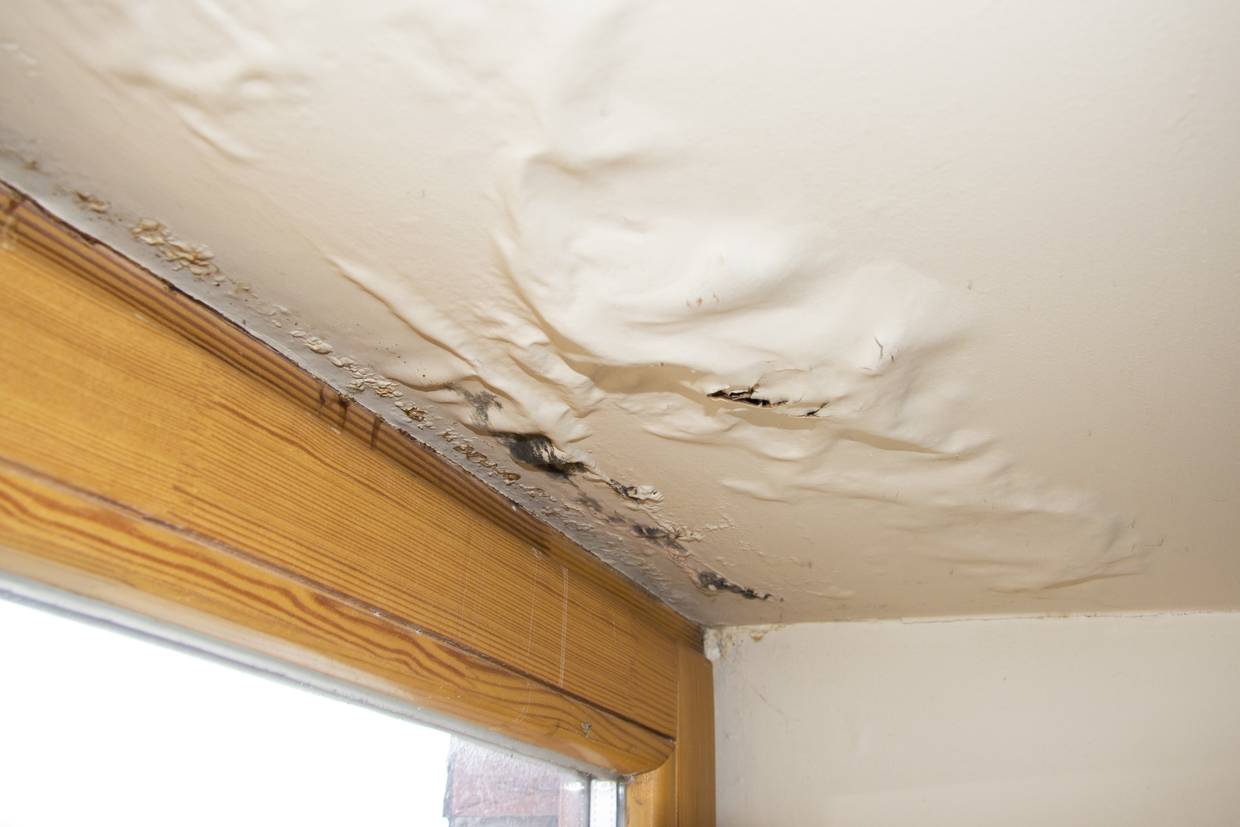
Ceiling stains are typically addressed as cosmetic issues.
They’re scrubbed and sealed before being painted over only to pop up weeks or months later.
This pattern represents a disconnect between the repairs being made and the ones actually needed.
It is more useful to consider the stain as a signal moving through a system of roofing, ventilation, insulation, and structural pathways than as a discoloration of drywall.
This change of view alters the way the problem is tackled.
The stain isn’t the problem. It is the endpoint of a chain of events that continues until the source is properly addressed.
Ceiling Stains as System Failures
A ceiling is not meant to trap or control moisture. If discoloration is present, it indicates that water has already penetrated several protective barriers.
Roofing materials, underlayment, flashing, and ventilation systems all exist to monitor moisture flow.
If any single one of these fails to function properly, the system is at risk.
Water travels along the path of least resistance, frequently down insulation or wooden beams.
It might have traveled several feet from where it entered before reaching your ceiling. That is why getting rid of an obvious stain without tracing the path almost guarantees its return.
The Role of Intermittent Leaks
Not all leaks are constant. Some occur only under certain conditions, making them difficult to diagnose.
The roof could work fine in light rain but not in wind-driven rain.
Likewise, small cracks or loose shingles can only permit water penetration when pressure is applied in specific directions.
These periodic leaks form a misleading pattern. The stain develops and dries to fade for a while.
This gives the impression that the issue has resolved itself. In reality, moisture is still entering the system in cycles, slowly eroding materials and increasing the damaged surface area.
Why Timing Matters
Knowing when a stain occurs can give clues. If it shows up after significant rains, the roof covering or flashing is probably involved.
Condensation and ventilation could be factors if it becomes more noticeable in cooler months. Timing is a factor in the diagnosis and not just a detail.
Ventilation: The Hidden Contributor
Many recurring stains are not caused by direct leaks at all.
A lack of ventilation may cause warm moist air to become trapped in the attic. This air condenses where it comes into contact with cooler surfaces.
This water eventually pools up and starts to work its way into the ceiling materials.
This is especially seen in houses that have increased their insulation levels without changing the ventilation.
The attic is better sealed, thus conserving energy but limiting moisture loss. This causes a gradual accumulation, leading to staining.
Signs of Ventilation Issues
- Musty odors in the attic
- Damp insulation or wood surfaces
- Frost buildup in colder weather
- Stains that appear without obvious roof damage
These signs indicate an inside problem and not an outside one. Ventilation is frequently a solution that can correct the situation without major structural work.
Flashing and Transition Points
Roofs are not uniform surfaces. They feature joints, edges, and intersections where materials connect.
The transition points are particularly susceptible to failure.
These areas are sealed with flashing but can become compromised over time from weather elements and thermal expansion. Typical trouble spots are:
- Chimneys
- Skylights
- Roof valleys
- Vent pipe openings
If the flashing fails, water may seep in little by little. The leaks are typically very small and may not even be noticed until the stain is spotted within the residence.
When Repairs Are Not Enough
Repeated staining may be a sign that you need a whole roof replacement.
Repairing localized defects is a temporary solution. It will not cure material fatigue and extensive wear.
At this point, homeowners begin to consider larger interventions such as a new roof installation.
This can be a pretty big investment, but it can remove several failure points all at once.
The decision should be made based on the condition of the roof as a whole, not on a single stain.
Evaluating the Bigger Picture
There are a number of considerations that will help you decide whether it’s better to repair or replace:
- Age of the roof
- Frequency of leaks
- Extent of visible damage
- Energy efficiency concerns
When multiple problems exist, patching just one area is likely to cause more long-term costs.
The Cost of Delay
Recurring stains can be more than an aesthetic problem.
Moisture is detrimental to structural integrity as well as indoor air quality.
Wood can rot, mold may occur, and energy costs may go up because of poor thermal barriers.
This is where knowing the cost of replacing a roof matters. Replacement may initially appear costly but can avoid a bunch of smaller repairs over time.
More importantly, it will prevent any further harm to the home’s internal structure.
Preventative Thinking Instead of Reactive Fixes
Recurring stains are a reminder that reactive maintenance is not a viable option.
Solving problems only when they are evident is a vicious circle that’s hard to escape.
Preventative roof care is a better solution that involves locating vulnerabilities before they become interior issues.
Key Preventative Practices
- Conducting seasonal roof inspections
- Clearing debris from gutters and drainage paths
- Checking flashing and sealants regularly
- Monitoring attic ventilation and insulation balance
These actions do not make every problem go away, they do lessen the chances of it coming back.
Moisture Pathways Inside the Home
While the roof may be performing fine, there can be other factors inside that lead to ceiling stains. Water can enter ceiling cavities from:
- Plumbing leaks
- HVAC condensation
- High humidity in the interior
- They are not directly tied to the roof and are overlooked as a source.
A systematic approach is needed to trace moisture pathways.
It’s about verifying multiple systems, not taking anything for granted as a single point of failure.
This is particularly significant in multi-level dwellings, where water may be able to flow through the house before it is seen.
Rethinking the Stain
A ceiling stain is more than a maintenance problem. It’s a type of home structure feedback.
It signals that water is flowing where it shouldn’t and current barriers are not working as intended.
Stains are not a cosmetic issue, treating them as a diagnostic tool changes the game. It promotes deeper investigation, strategic decision making, and ultimately long-term solutions.
A More Durable Resolution
To break the cycle of reoccurring stains, there must be an alignment between cause and response.
Surface treatments are good for appearance but system level issues require system level solutions.
The solution could be better ventilation, specific repairs, or complete replacement, but all involve correctly pinpointing the problem.
If the underlying issue is fixed, the stain will not reappear.
Not because it’s covered, but because the conditions that made it are no longer present. This difference is what makes temporary solutions different from permanent solutions.
Endnote
It is hard to get rid of ceiling stains because they are not isolated occurrences.
They are persistent outputs of a system that has not been completely corrected.
Patterns emerge once you start to evaluate how roofing, airflow, and internal moisture are all related.
This wider perspective minimizes trial and error or repeated repairs, and enables homeowners to shift from quick fixes to long-term solutions.