


I manufacture sinks and faucets for a living, and the two parts of a kitchen you touch all day — the faucet you pull on thirty times and the basin you stare into while scrubbing pans — cost less to replace than a run of new cabinet doors.
Both swaps together run $300 to $1,500 and change how the whole room reads.
The order matters: faucet first, sink second, plus the things to refuse to spend money on at all.
Swap the faucet first: $120–$350 and one afternoon
A faucet swap is the highest-visibility change per dollar in the house, and genuinely DIY. Two specs decide whether it still works well in five years.
The cartridge. Insist on a ceramic-disc cartridge. Two polished ceramic plates seal the water path and don’t wear like rubber washers — that’s the difference between a faucet that drips at year three and one that never drips.
The finish process. PVD (physical vapor deposition) bonds the finish in a vacuum chamber; electroplating deposits a thinner layer that wears and etches faster, especially in hard water. Pay the extra $30–$50 for PVD — it’s the cheapest insurance in this project.
Choose the color by your water, not by Pinterest:
- If you have hard water and won’t wipe the faucet daily → choose brushed nickel or brushed stainless. The satin texture hides spots and fingerprints.
- If you love matte black → it hides water spots too, but shows dried mineral film as a gray haze and tolerates only gentle cleaners. Scouring powder dulls it permanently.
- Polished chrome is the cheapest and most brilliant — and it shows every droplet and etches fastest in hard water. Choose it only if wiping is already a habit.
Before ordering, look under the sink deck. One hole or three? Three holes on 4-inch centers means a single-hole faucet needs a deck plate to cover the spares — many include one, but check the listing.
You can compare kitchen faucets by spout height, cartridge type and finish side by side before deciding.
Gotcha #1, and it floods kitchens: the shutoff valves under your sink may not have been turned in 20 years.
Test them the night before — close both, open the faucet, confirm the flow dies completely.
Force a seized valve mid-job and the stem can snap with the water on: an emergency plumber at $150–$300 evening rates, plus a soaked cabinet. A weeping valve is a $15 quarter-turn angle stop. And always fit new braided supply lines ($10–$15 a pair); reusing 15-year-old lines to save twelve dollars is how slow leaks start.
The bathroom version: $80–$200, same afternoon
Same job, lower price, one rigid constraint: the new faucet must match the holes already in your vanity top.
- One hole → single-hole faucet.
- Three holes, 4 inches apart → centerset (one base plate covers all three), or a single-hole with a deck plate.
- Three holes, 8 inches apart → widespread. Three separate pieces, a more built-in look, a fiddlier under-counter assembly.
The rule that saves a return shipment: if your top has 4-inch centers, you cannot install a widespread without a new vanity top. No adapter fixes that.
The sink swap: where the real money and gotchas live
The first question isn’t material — it’s your countertop.
If your counter is laminate → choose a drop-in (top-mount) sink, full stop. Undermount rims need stone, quartz or solid surface; laminate’s particleboard core can’t hold the clips and swells the first time the seal weeps.
If you have stone with an existing undermount → measure the cutout first. A fabricator can recut a slightly bigger opening for roughly $300–$600, but stone can never be cut smaller.
From there, the materials:
Stainless steel is the budget answer and the easiest install: 15–25 lb, one person can set it.
Buy 16-gauge over 18 — lower number means thicker steel, less drumming — and check for sound-dampening pads underneath; cheap sinks skip them and every dropped spoon rings. Expect $150–$400.
Quartz composite is my pick for most swaps. Roughly 70–80% crushed quartz in resin: non-porous, never needs sealing, and noticeably quiet — a dropped colander lands with a thud, not a clang.
At 40–60 lb for a 33-inch model, a standard cabinet carries it unmodified. One real limit: a moderate heat ceiling, so keep a trivet handy. Budget $300–$600.
Fireclay farmhouse is the showpiece, and the one swap I tell people to slow down on.
We fire these at 1,200–1,300°C with the glaze fused into the clay, which is why the surface shrugs off heat, stains and scrubbing for decades. But a 33-inch sink weighs 100–120 lb empty — fill a double bowl and you’re hanging close to 200 lb inside the cabinet.
That demands a support frame ($30 of 2×4s, an hour of work), a cut-down cabinet face for the apron, and two people on install day.
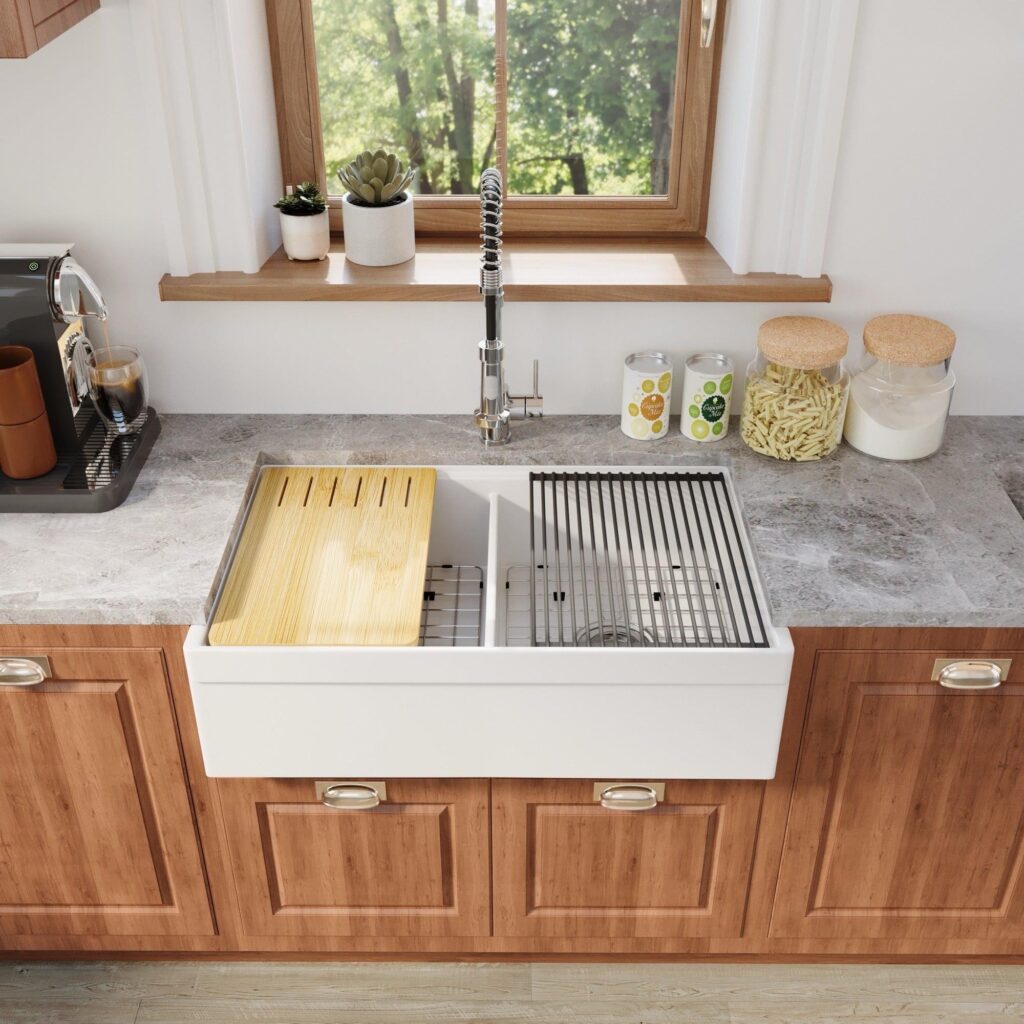
Gotcha #2, and it ruins countertops: fireclay shrinks in the kiln with a ±2–3 mm tolerance, so two “identical” sinks differ slightly. Never let a fabricator cut stone from brochure dimensions — template from the actual sink in your garage.
Cut from the PDF and the reveal ends up uneven or gapped; the fix is a $300+ recut at best, a $1,500–$3,000 new slab at worst.
Check a model’s outside dimensions, bowl depth and shipping weight for a quartz sink against your cabinet before you order, not after.
| Material (33″ sink) | Weight | Sink price | Install cost on top | The honest catch |
| Stainless, 16-gauge | 15–25 lb | $150–$400 | $0 DIY–$250 | Water spots, fine scratches |
| Quartz composite | 40–60 lb | $300–$600 | $150–$350 | Trivet for hot pans |
| Fireclay farmhouse | 100–120 lb | $600–$1,200 | $400–$800 (frame + cabinet mods) | Weight, templating, two installers |
What to skip
The designer-brand markup. A $700 faucet and a $250 one frequently run the same ceramic-disc cartridge. Pay for PVD and the cartridge spec, not the logo.
Undermount conversion on laminate. The most-attempted bad idea here — the counter physically can’t hold it.
A vessel basin during a bathroom swap. A bowl on the counter needs a much taller spout, a non-overflow drain and usually a lower vanity. That’s a redesign, not a swap.
New countertops. The point of these two swaps is that counters, cabinets and tile stay. The moment the counter moves, you’ve left the $1,500 project and entered the $15,000 one.
Your weekend, in order
- Thursday evening: close both shutoff valves under each sink, open the faucet. If the flow doesn’t die completely, add new angle stops ($15 each) to the list.
- Count and measure: faucet holes and their spread; cabinet interior width; existing cutout; bowl depth. A sink needs a base cabinet at least 3 inches wider than the sink.
- Photograph the under-sink plumbing. A photo solves at the hardware store what a description can’t.
- Order the faucet first, with new supply lines. Order the sink only after the measurements check out.
- Saturday morning: faucet. A basin wrench ($15) is the only special tool. First-timers need 1–2 hours, mostly lying in the cabinet arguing with the old mounting nut.
- Saturday afternoon: sink, if it’s a stainless or quartz drop-in — silicone, new strainer, 3–4 hours.
- If it’s fireclay, don’t do it this weekend. Build the frame, template the top, book a second pair of hands, and do it properly the following one.
Run that sequence and Sunday night looks like this: a faucet that shuts off crisply, a sink that doesn’t ring or stain, and a renovation budget still mostly in your bank account.