

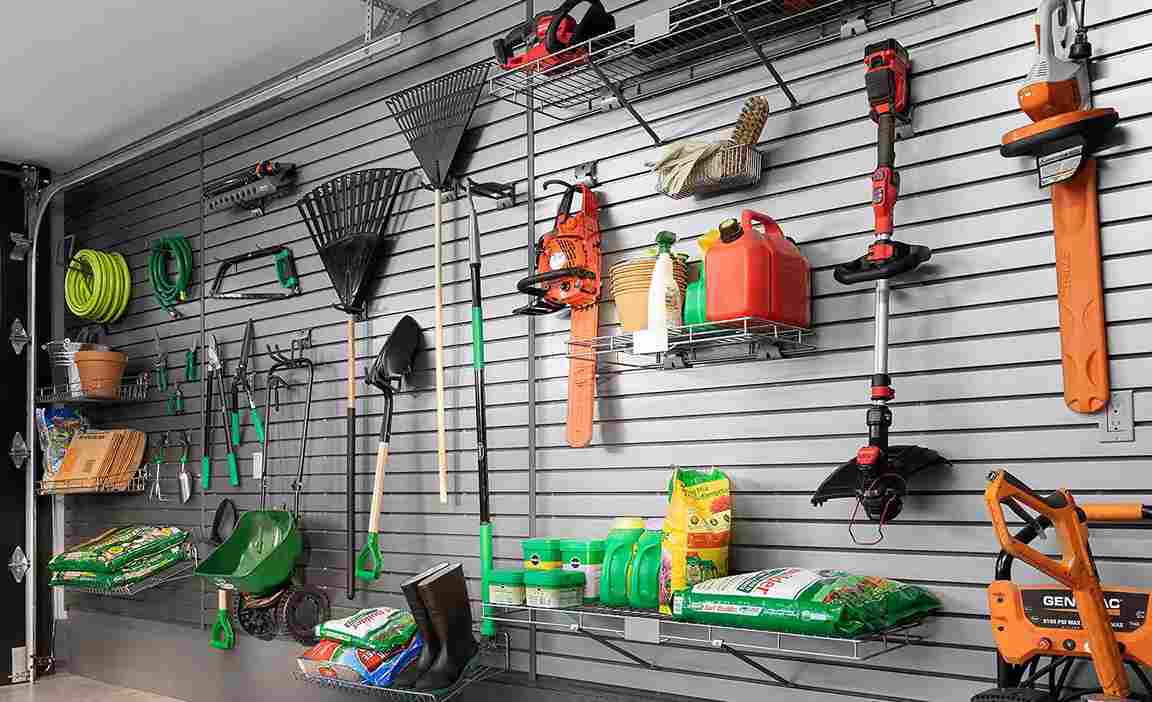
One need only attempt a few fix-it projects to realize that tools tend to multiply. What starts as a small collection soon results in drawers overflowing with wrenches, screws, and that obscure gadget from the last project.
For smaller houses in particular, this is truly a problem.
You can find them scattered around drawers, stuffed under sinks, and many of them collected into piles in corners.
So, when you need something, you can’t find it, and the frustration of searching through chaos often exceeds the frustration of the repair itself.
To avoid this dilemma, here are smart storage ideas for your tools, which you can readily apply. But first, let’s understand why having proper storage is integral, especially for crammed spaces.
Why Is Proper Storage Important
Keeping everything in one general area rarely works long-term.
In small homes or living spaces where all square footage counts, disorganized tools create visual clutter and safety hazards.
Tossed sharp items in drawers may cause injury. Heavy objects balancing on the edge of a shelf will fall over time.
Garden equipment stacked against the wall can cause people to trip over it.
Aside from safety, this lack of organization impairs your ability to properly maintain your home.
When a simple repair calls for a treasure hunt to locate needed tools, those small repairs aren’t happening.
This is where the need for insightful tool storage solutions presents itself.
The approach makes tools go from being disorganized liabilities to valuable assets. And it doesn’t necessarily involve an elaborate garage workshop. What it entails, however, is thinking strategically about the space you have.
Common Storage Mistakes That Make Everything Worse
One common mistake is treating all tools as equally important based on frequency.
People buy big toolboxes and put everything in without any consideration of the frequency of use.
So, the month-old hammer sits at the bottom of the box, halfway through the Allen key set, which you’ve used twice in five years.
Another common error is failing to take environmental factors into consideration.
Tools get stored in damp basements or uninsulated sheds where temperature fluctuations and moisture accumulate.
Yet, when it comes time for repairs, users seem shocked when they see the onset of rust or decaying handles.
Perhaps the biggest mistake of all is the failure to develop any consistent system.
Tools go back “wherever there’s space” rather than to designated spots, which means organization gradually dissolves into chaos.
With the lack of easy habits to support the organization of putting things away correctly, even the best systems will ultimately fail.
Maximizing Limited Space Intelligently
Living in small spaces requires creative solutions, and possibly the most underused alternative is the wall space.
Vertical storage options keep the unused space from going idle.
To provide greater versatility, you may consider installing French cleats.
These will allow you to hang different holders, making it easier to change configurations as necessary. Magnetic strips are also great and work particularly well for smaller metal objects such as screwdrivers and wrenches.
For items that are not hung on the wall, the decision between fixed and portable storage depends on your working style.
The portable tool boxes are ideal for frequent moving of items.
More modern systems help you stack securely and allow you to pick exactly what you need.
The modular systems will also accommodate your growing collection.
Fixed storage is appropriate for static items. An organized rolling utility cabinet is useful for considerable storage in a compact footprint when located in a utility room and has sturdy handles and smooth-rolling wheels.
Frequently used items should be easily accessible indoors, maybe in a utility room or in an organized cupboard.
Other equipment and garden furniture not frequently required may be stored in the garage or in sheds, as long as there is sufficient protection against bad weather.
Protecting Tools and Creating Usable Systems
The main cause of rust and deterioration is moisture. The change in temperature affects the garage, causing moisture to form.
For those tools kept in potentially damp places, the wall storage will help prevent them from touching the floors, promoting good circulation.
The resin boxes are more resistant to moisture, making them the best choice for tools kept outside.
The ideal system will be worthless if it is too complicated to maintain.
You need storage that makes putting things away easier than leaving things out.
Small parts storage with clear compartments makes it immediately clear where screws go. For larger tools, shadow boards or foam storage create an “at home” place for everything.
When dealing with shared spaces or “multi-use” areas, consolidation becomes an important factor.
For example, the utility room and/or the laundry room require tool storage that doesn’t clash with other uses.
This may involve something as space-efficient as a thin “rolling” cabinet system that fits into one corner or wall storage that keeps tools away from countertops.
The space under the stairs is an often-wasted space that can be surprisingly effective.
Maintaining Organization Over Time
Setting up tool storage is one thing, but keeping it organized is another.
Regular reviews of your storage setup matter more than people realize. Every six months, it is essential to assess what is being used against what is stored.
Tools that haven’t been used in the last year could be considered for donation or storage.
This is also a good opportunity to clean the tools and check if any of them are damaged.
As your tool collection increases, plan for it instead of waiting until overflow occurs. Modular storage solutions excel at this task because they can accommodate additional storage without requiring total rebudgeting.
Be aware of what continually falls into a state of disorganization.
Perhaps a problem with some of the tools never finding their “home” is not that you are failing to return them, but that the system itself is flawed. Maybe those tools belong somewhere more convenient.
Final Thoughts
The difference between a home where tools are an asset and one where they’re a constant frustration often comes down to storage decisions.
Small homes don’t have to mean disorganized tools. They just require more thoughtful approaches to making every square inch count.
Frequently Asked Questions
Combine wall storage for frequently used items with small containers for all other items. Utilize walls, doors, and ceiling-mounted storage racks. Designate separate homes for all items rather than separate “tool areas.”
Tools that are used frequently can be stored indoors. Garages work well for larger equipment and garden tools if the space stays reasonably dry. The tools will be damaged if the garage is damp.
The main offender is moisture. Moisture could either be humidity or condensed water. Temperature changes result in the formation of condensed water on metal surfaces. Dust is also an issue.
A detailed examination once every six months may be effective. Nevertheless, minor adjustments are more important than overhauling. Repetitive problems with organizations need to be addressed immediately.
Absolutely. For example, systems like Festool Systainers or portable toolboxes are available. Start off small and scale upwards as required. Move only those tools required for the task at hand.