

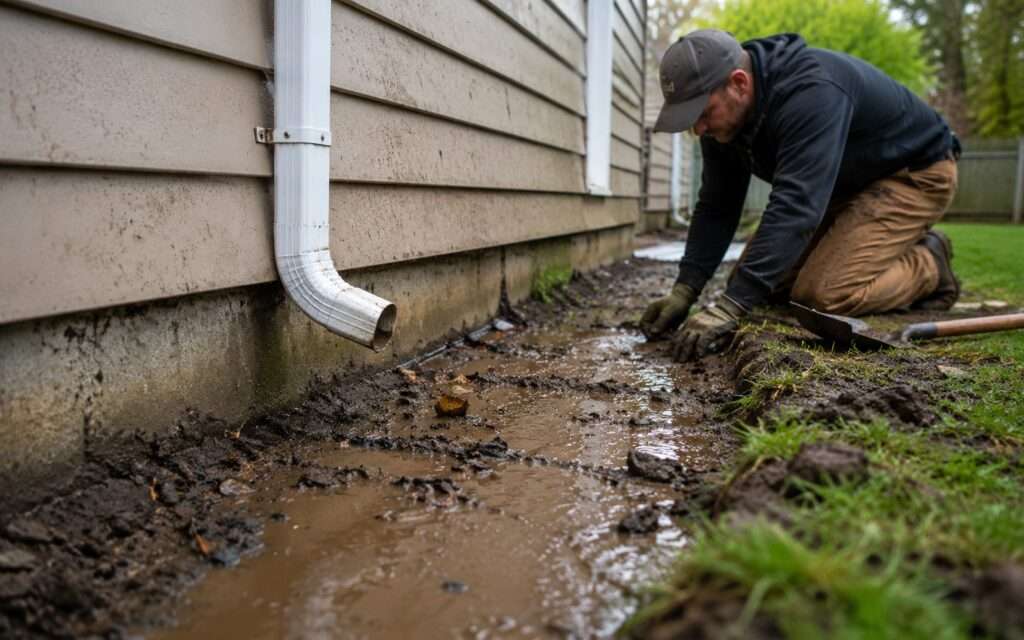
Most homeowners have stepped into a soggy patch of grass and thought, “That will probably dry out in a day or two.”
Sometimes it does. Sometimes it keeps happening for months, quietly pointing to a larger problem that is easy to ignore until repairs become expensive.
Water rarely stays where it is not causing trouble.
If it cannot move away from a property properly, it usually finds another path. That path may lead through landscaping, beneath foundations, into crawl spaces, or toward areas homeowners never intended to get wet.
Water Around the House Is Not Always Harmless
Many drainage problems start small enough to seem unimportant.
A puddle near a walkway. Soil that remains wet longer than the rest of the yard.
Water collecting near the foundation after a heavy rain. None of these situations automatically indicates serious damage, but they should not be ignored either.
Properties are designed to move water away from structures as efficiently as possible.
When that process is interrupted, excess moisture begins accumulating where it does not belong.
Over time, this can affect landscaping, foundations, hardscape, and even indoor areas. The earlier these signs are noticed, the easier they are usually to address.
One area homeowners often overlook is the way roof runoff is handled after rainfall. Gutters may collect water successfully, but that is only part of the process.
Effective downspout rainwater drainage helps direct water away from the home so it does not pool near foundations or create recurring moisture problems around the property.
Standing Water That Refuses to Go Away
A yard should not behave like a temporary pond after every storm.
While some water accumulation immediately following heavy rainfall is normal, standing water that remains for days often indicates poor drainage.
This is particularly true if the same areas repeatedly collect water regardless of the season.
The issue may involve compacted soil, improper grading, blocked drainage systems, or runoff patterns that direct water toward low spots.
Whatever the cause, persistent pooling deserves attention because prolonged moisture can damage grass, weaken root systems, and create favorable conditions for pests.
Homeowners sometimes become accustomed to seeing these puddles and stop noticing them. The ground usually does not share that attitude.
Soil Erosion Around the Property
Water tends to leave clues behind. One of the more visible signs of drainage trouble is erosion.
Soil may begin washing away from flower beds, around walkways, or near the foundation.
Small channels can develop where water repeatedly follows the same path.
At first, erosion may appear cosmetic. Eventually, it can affect landscaping investments and alter the way water moves across the property.
In more difficult situations, it may contribute to instability around structures and hardscape features.
Freshly exposed roots, displaced mulch, and uneven ground often suggest that water is moving with more force than intended.
Foundation Issues Can Begin Outside
Not every foundation crack is caused by drainage problems.
At the same time, excess water near the home increases the risk of foundation-related concerns over time.
When soil repeatedly expands and contracts due to changing moisture levels, pressure can be placed on foundation walls and structural components.
Homeowners may notice small cracks, sticking doors, uneven floors, or gaps around windows.
These symptoms can have multiple causes, but poor water management should be considered as part of the investigation.
Water that remains close to the structure for extended periods is rarely doing the property any favors.
Basement and Crawl Space Moisture
Moisture inside a basement or crawl space often points to issues occurring outside.
A damp smell, visible water stains, mold growth, or increased humidity may indicate that water is finding ways into areas where it should not be.
Sometimes the problem originates from grading issues. Other times, overflowing gutters or drainage failures contribute to the situation.
Many homeowners focus on treating indoor symptoms without addressing the source.
That approach can provide temporary relief, but the underlying moisture problem often remains.
Identifying where water is entering the system is usually more important than repeatedly cleaning up the results.
Grass and Plants May Reveal Problems
Landscaping can serve as an early warning system.
Certain sections of a yard may appear noticeably greener, thicker, or faster-growing than surrounding areas because excess moisture is present.
In other locations, plants may struggle because roots remain saturated for too long. Neither extreme is ideal.
Healthy landscapes generally benefit from balanced moisture levels.
When some areas consistently receive too much water, the difference often becomes visible in plant health, soil conditions, and overall appearance.
Observing these patterns can provide useful clues before larger drainage issues develop.
Gutter Overflow During Rainstorms
Many homeowners assume water spilling over the sides of gutters means the gutters simply need cleaning.
Sometimes that is true.
However, recurring overflow can also indicate capacity issues, improper slope, blocked downspouts, or drainage systems that are unable to move water away effectively.
Overflowing gutters allow water to fall directly near the foundation, increasing the likelihood of erosion and moisture problems.
Watching how water behaves during a rainstorm can reveal a surprising amount about a property’s drainage performance. The water often tells the story if someone takes the time to look.
Cracks in Driveways and Walkways
Drainage issues do not only affect soil and foundations.
Concrete surfaces, patios, walkways, and driveways may also show signs of trouble when water repeatedly accumulates underneath or alongside them.
Over time, shifting soil and erosion can create cracks, uneven sections, or settling. These changes may occur gradually, making them easy to overlook.
When damage appears in combination with standing water or erosion, drainage should be considered as a possible contributing factor.
Addressing water movement early can sometimes prevent more extensive repairs later.
The Problem Often Grows Slowly
One reason drainage issues are frequently ignored is that they rarely develop overnight.
Water damage tends to be patient. Small puddles become larger.
Minor erosion becomes more noticeable. Foundation problems progress slowly.
Moisture accumulates over months or years rather than days. Because the changes happen gradually, homeowners often adapt to them without realizing conditions are worsening.
By the time obvious damage appears, the underlying issue may have existed for quite some time.
Paying attention to these warning signs helps identify problems before they become more difficult and expensive to address.
A property does not need to be experiencing major flooding to have a drainage issue.
Sometimes the earliest signs are subtle. The key is noticing them before water has the opportunity to create bigger problems elsewhere.