

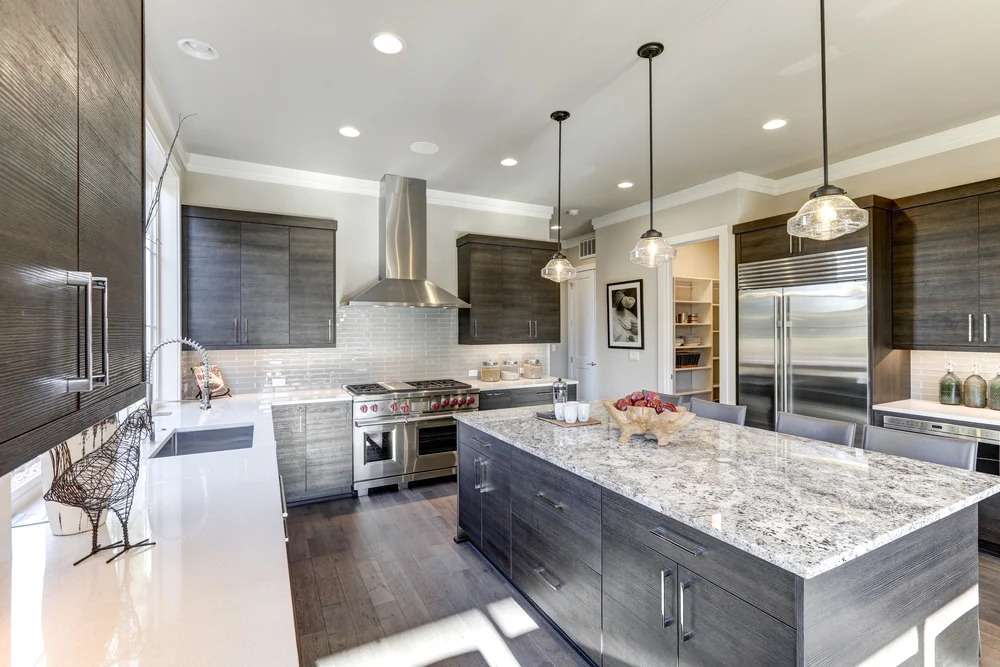
Why Your Countertop Choice Near the Cooktop Really Matters
If you’ve ever flinched watching a hot pan slide across your brand-new counter, you already know that not every surface is built for real cooking life.
Your kitchen isn’t just a room with appliances in it. It’s where Saturday morning pancakes happen, where you teach your kids to stir a pot of soup, where you unwind after a long day with a glass of something cold and a recipe you’ve been meaning to try.
The surfaces in that space should work as hard as you do, and they should still look beautiful while doing it.
That’s exactly why the quartzite vs. granite conversation matters so much, especially when you’re talking about the counter right next to your cooktop.
Both are natural stones. Both are gorgeous.
Both get recommended constantly by designers and fabricators. But they don’t behave the same way when exposed to the repeated heat splatter, grease pops, and thermal shock that happen around a working stove.
By the time you finish reading this, you’ll understand the real science behind heat resistance for both stones, and you’ll feel genuinely confident picking the right one for your kitchen and your cooking style. Let’s get into it.
A Quick Geology Refresher: How Quartzite and Granite Are Formed
You don’t need a geology degree to pick a countertop, but knowing how these stones are made actually helps explain why they perform differently in your kitchen.
Granite is an igneous rock, which means it formed from cooled magma deep beneath the earth’s surface.
It’s composed mainly of quartz, feldspar, and mica, and those interlocking crystals give it a solid, durable structure with decent heat tolerance. Think of it as rock that was born from fire and cooled slowly into something beautiful and tough.
Quartzite takes a different path. It starts life as ordinary sandstone, but gets transformed by intense heat and pressure deep underground.
This metamorphic process fuses individual quartz grains together into something much harder and denser than the original sandstone.
If you want an analogy, quartzite is sandstone that went through nature’s pressure cooker and came out the other side practically bulletproof.
You can read more about how metamorphic rocks like quartzite form from the USGS if you’re curious about the details.
Here’s the key difference that matters for your kitchen: quartzite has already survived extreme geological heat, which contributes to its high thermal stability. Granite is heat-resistant too, but its mineral mix includes components with varying thermal expansion rates, and that can matter over time.
One important note before we move on: don’t confuse quartzite (a natural stone) with quartz (an engineered countertop material held together with resin binders). Quartz countertops are far more vulnerable to heat damage, and they’re a completely different product.
Heat Resistance Head-to-Head: What the Numbers Actually Say
So which stone actually handles the heat better when dinner gets intense?
Let’s start with hardness. On the Mohs hardness scale, quartzite ranks around 7, while granite typically falls between 6 and 7 depending on its specific mineral composition.
Hardness and heat resistance aren’t the same property, but they correlate loosely: a harder, more tightly bonded stone tends to handle thermal stress with fewer issues.
In terms of raw thermal tolerance, granite can generally withstand temperatures up to about 1,200°F before any structural concern arises.
Quartzite’s fused-quartz composition gives it comparable or slightly superior heat endurance.
Neither stone is going to crack from a hot pan under normal cooking conditions.
But here’s where it gets interesting for the cooktop zone specifically. Heat splatter near a stove is not the same as placing a 500°F skillet directly on the stone.
Splatter involves rapid, localized temperature spikes, tiny bursts of very hot oil or liquid hitting the surface.
Both stones handle this well, but granite’s varied mineral composition means certain darker minerals can occasionally experience micro-stress from repeated thermal cycling over many years.
It’s not dramatic damage, but if you’re someone who cooks every single night and your counter lives inches from a gas burner, those micro-stresses add up.
Sealant plays a role too. Most granite countertops are sealed, and some sealants can discolor or break down with prolonged heat exposure.
Quartzite, being denser and less porous, often requires less frequent sealing, which means fewer sealant-related heat issues over time.
The Natural Stone Institute’s care guidelines offer a solid overview of how to maintain both stone types.
The verdict here: quartzite has a slight edge in raw thermal performance near a cooktop, but both stones are strong performers.
If you’re curious about how different surface coatings respond to heat, that’s another layer worth exploring. For most homeowners, though, the bigger differentiator will come down to maintenance and finish durability, which brings us to the next section.
Beyond Heat: Stains, Scratches, and Daily Wear Near the Stove
Heat resistance is only part of the story when your counter sits inches from a working cooktop.
Oil splatter, acidic sauces, red wine, and the occasional aggressive scrubbing session all come into play.
Let’s break it down:
Porosity: Granite is more porous than quartzite. Without consistent resealing, typically once a year, granite can absorb cooking oils and tomato-based sauces, leading to staining in the cooktop zone. Quartzite’s tighter grain structure makes it naturally more resistant to staining, and spills tend to sit on the surface longer before any absorption starts. That gives you more time to wipe things up.
Scratch resistance: Quartzite’s higher Mohs rating means it resists scratching from sliding pots, cast iron skillets, and heavy cookware better than granite. If you’re the kind of cook who moves heavy pans around without thinking twice, this matters.
Etching: Quartzite is generally resistant to acid etching. Some granites, especially lighter-colored varieties with higher calcite content, can show dull spots from lemon juice or vinegar splashes. If you cook with a lot of citrus or acidic ingredients, this is worth knowing.
Cleaning: Both stones clean up well with mild soap and water. Avoid harsh chemical cleaners on either surface. For more detailed countertop maintenance tips from Consumer Reports, their guide covers best practices across multiple materials.
Here’s a quick side-by-side comparison:
- Heat resistance: Quartzite: excellent | Granite: very good
- Porosity: Quartzite: low | Granite: moderate
- Scratch resistance: Quartzite: high (Mohs ~7) | Granite: moderate-high (Mohs 6-7)
- Acid sensitivity: Quartzite: low | Granite: varies by composition
- Sealing frequency: Quartzite: every 2-3 years | Granite: annually
Choosing the Right Stone for Your Kitchen Style and Lifestyle
Now that you know the performance differences, how do you decide which stone is right for your kitchen and your life?
The avid home cook: You use the cooktop daily, you fry frequently, and you want surfaces that don’t demand constant babying. Quartzite is likely your best fit. Its superior heat cycling tolerance, lower porosity, and scratch resistance make it a workhorse that still looks stunning after years of real use.
The style-conscious moderate cook: You love a beautiful kitchen, you cook a few times a week, and you want the widest possible range of colors and patterns to choose from. Granite offers an enormous variety of veining, movement, and color options, from deep blacks to warm golds to cool blues. Its heat resistance is more than adequate for typical cooking, and it tends to be more budget-friendly than premium quartzite slabs.
The design-forward homeowner: You want a statement piece that looks like marble but won’t fall apart near a hot stove. Quartzite varieties like Taj Mahal or Sea Pearl deliver marble-like aesthetics with dramatically better durability, making them ideal near a cooktop where actual marble would be a risky choice.
No matter which direction you lean, sourcing matters. The quality and specific mineral composition of any individual slab will affect its performance.
Working with experienced suppliers of granite and marble countertops helps ensure you get a slab that matches both your aesthetic vision and your kitchen’s functional demands.
One last practical note: proper installation is essential for long-term performance with either stone.
Heavy slabs near cooktop cutouts need adequate support, so make sure your fabricator and installer are on the same page about structural requirements.
Your Countertop, Your Kitchen, Your Call
Here’s the bottom line: quartzite holds a slight performance advantage near a cooktop thanks to its geological origins, density, and lower porosity.
It’s the stone that already survived extreme heat once, and it shows. But granite remains a fantastic, durable, and genuinely beautiful option for most home kitchens, especially when you factor in its wider color range and friendlier price point.
Either stone, when properly sealed and maintained, will serve a working kitchen well for decades.
The right choice comes down to your cooking habits, your design preferences, and your budget.
So think about how you actually use your kitchen. Think about what makes you feel good when you walk into that space.
Then pick the stone that fits your life, not just your Pinterest board. Because the best kitchen counter is the one that lets you cook freely, clean up easily, and still makes you smile every time you lean against it.
If you’re curious about how different surface materials hold up under heat and daily kitchen use, Hooked Home has a detailed breakdown of Granitium nonstick coating and how it compares to traditional options, and it’s well worth a read if you’re deep in the research phase of your kitchen project.