

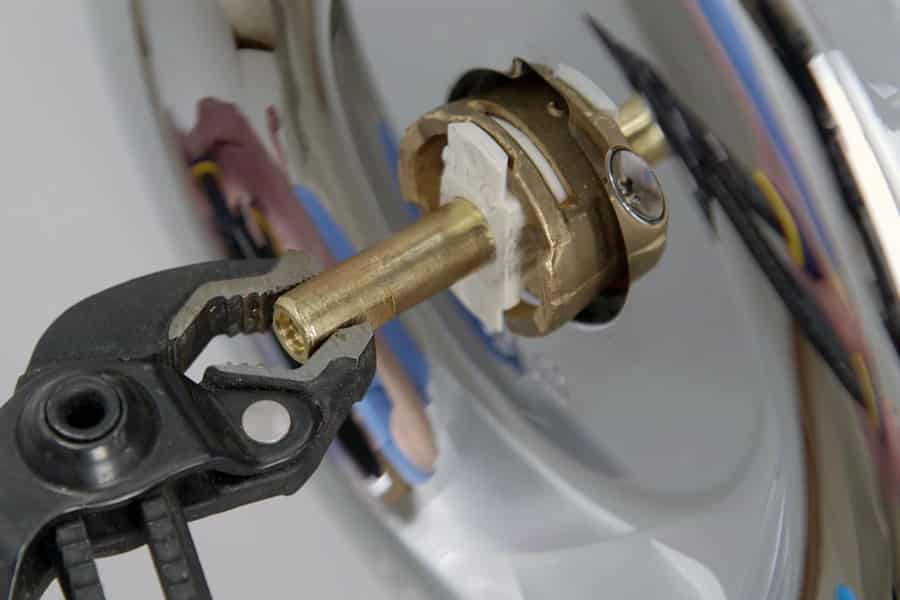
If you are dealing with a leaky shower or struggling to get the right temperature, there’s a high chance that your old shower valve is one to be blamed. Especially from the 1950s to 1970s, that are tool old, are always having such issues. That’s when it’s important to replace your old valve with the new one.
But, how do you identify an old shower valve? Is there any detailed guide on old shower valve identification? What are the different types of shower valves?
Well, worry not, as we are going to discuss everything in detailed, step-by-step.
In this post, we will guide you through everything you need to know about identifying an old shower valve, and and the different types of shower valves. No, it won’t be just a all of text, we will help you with the images so that you an identify the one that’s been fitted decades ago in your house.
Shall we start? Great! Let’s go!
Types of Old Shower Valves (1950s to 1970s)
The shower valves from the 1950s to 1970s have their own set of unique features and styles like the classic cross-shape handles or the metallic finishes. These details are more than enough to tell that if your valve belongs to a bygone era.
In this section, we will take a closer look at the most common types of old shower valves. This will help you identify the valve in your case.
Two Handled Valves
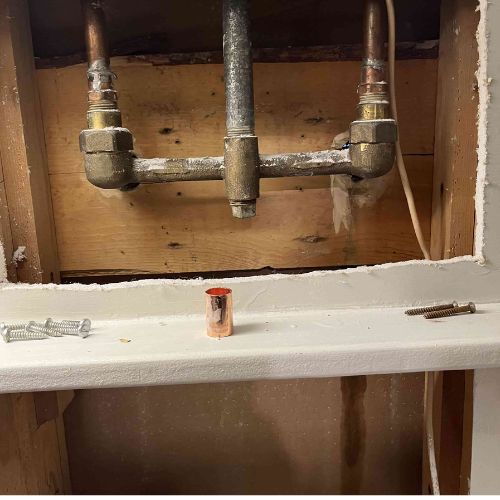
Two-handled valves were mostly used in homes that were built in the early 1900s, especially throughout the 1950s and 1960s. These valves come with two separate handles, one for hot and the other for cold water – allowing their users to manually adjust the water temperature by mixing both water flows into the valve.
These valves usually have ceramic or compression-style cartridges inside them. Most older models often had compression cartridges that required you to turn the handle multiple times to control the water flow and pressure.
How to identify?
You can identify this two-handle valve by removing its trim plate and looking for the maker’s logo or print on the stem or valve body. To know about its age, check the type of cartridge used on the valve stem, it can be compression or ceramic style. Another trick is counting the splines on the valve stem since different manufacturers use different designs in their valves.
If you are still unsure then you can take photos of the valve and ask online forums or visit hardware stores, they will help you identify the model.
Diverter Valves
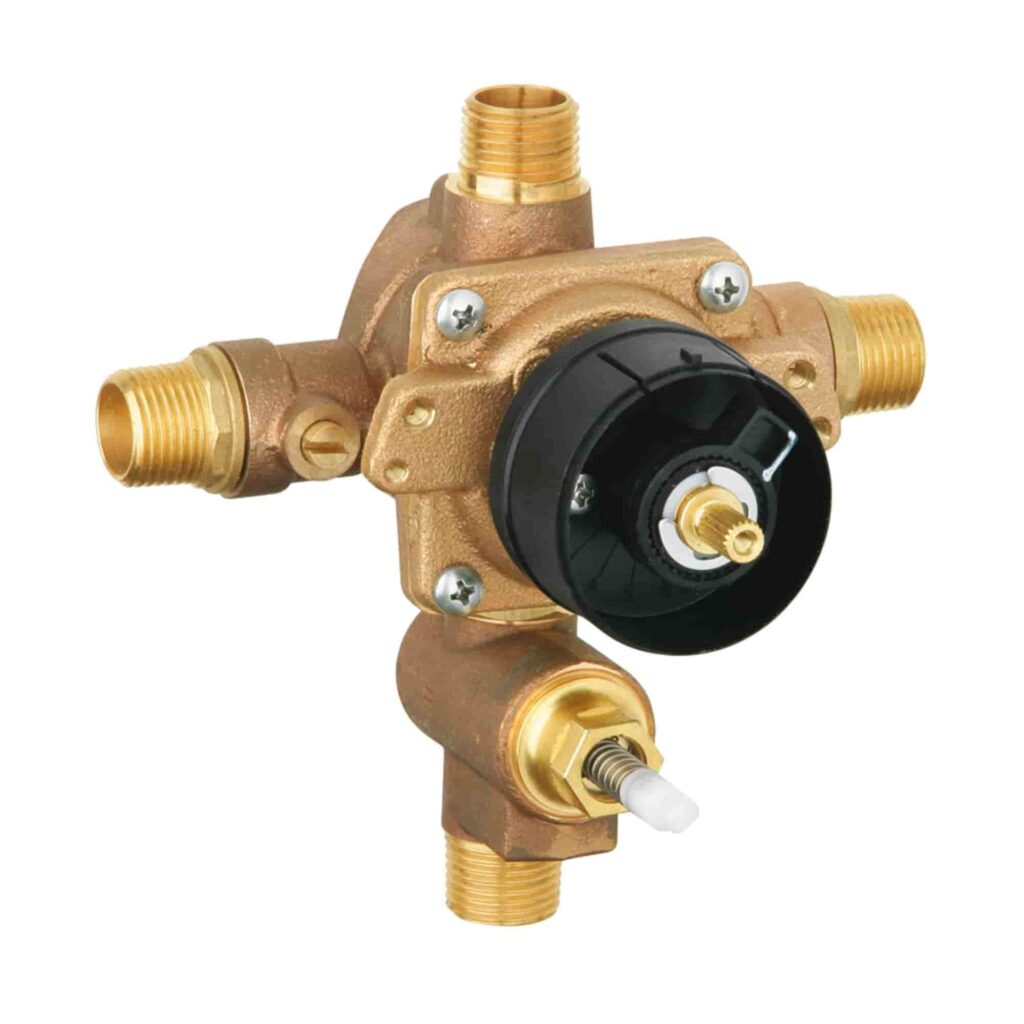
Diverter valves were plumbing mechanisms and they were mostly found in mid-century homes. They gained quite a popularity during the 1960s and 1970s.
These valves allow the users to control the water flow between different outlets like showerheads, or bathtub faucets, with a simple twist or pull of the handle.
How to identify?
To help you identify a diverter valve, first look behind the trim, it’s the decorative cover of the faucet or near the tub spout. You should be able to see a small lever or a separate knob that changes the direction of water flow. You can often see basic rubber gaskets or seals to control the water flow in the diverter valve.
To know the brand name or logo, you can check the valve’s structure, this will also help you determine its age. You can also check the handle setup to know the valve model.
Compression Valves
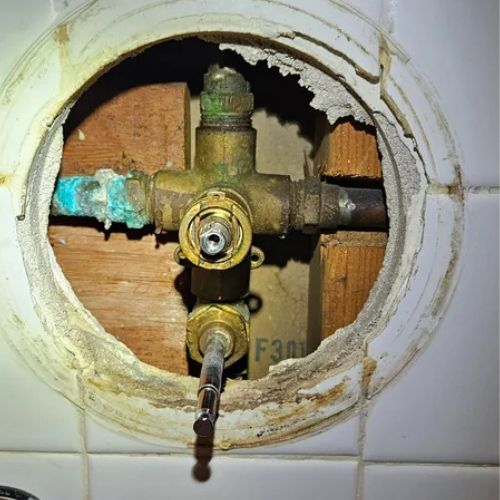
Compression valves are the oldest type of shower valves and were widely used in homes from the 1950s to the 1970s. These valves function by turning the handle to compress a rubber or silicon washer which then blocks the water flow. These valves also have two separate handles, one for cold and one for hot water.
Cartridge Valve
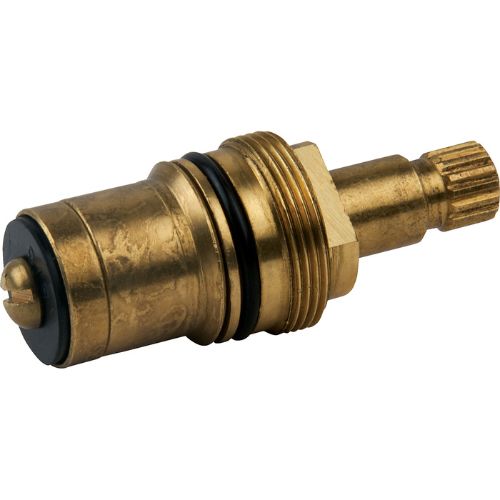
These cartridge valves were mostly used in the late 1960s and the 1970s as they were the more efficient alternative to older valve structures. You can find these valves in both single-handle and two-handle faucets. These valves allow the users to turn the handle quarterly to have smooth and precise control over the water flow and temperature.
How to identify?
To identify a cartridge valve, check if your faucet has a single handle and turns smoothly with one motion to control both the water flow and temperature, then it is likely a cartridge valve.
To know the model number and brand name, remove the handle and look for the cartridge inside the structure (it will be cylindrical). Look at the cartridge structure for any logo, prints, or manufacturer marking.
Ceramic Disc Valve
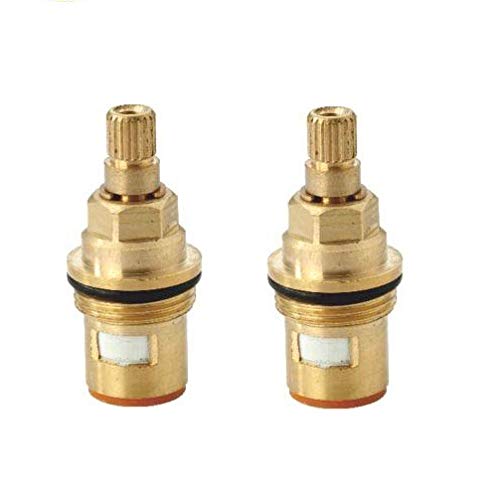
Ceramic disc valves were quite popular in the 1980s and the 1990s and are still used in many homes for the durability and reliability they offer. This valve is quite different from the older valves as it features two flat ceramic discs that are stacked together.
These discs are responsible for controlling the water flow by aligning or misaligning the openings. Ceramic disc valves allow users to adjust and control the flow of water and temperature with minimal effort.
How to identify?
To help you identify the ceramic disc valve, first look for a single-handle faucet and if it moves smoothly with minimal effort then it has a ceramic mechanism.
These types of valves just need a slight turn to adjust the water flow. So when you remove the handle and inspect the valve’s interior, you will see two shiny ceramic discs and this sets it apart from the previous valves.
Single Handle Valve
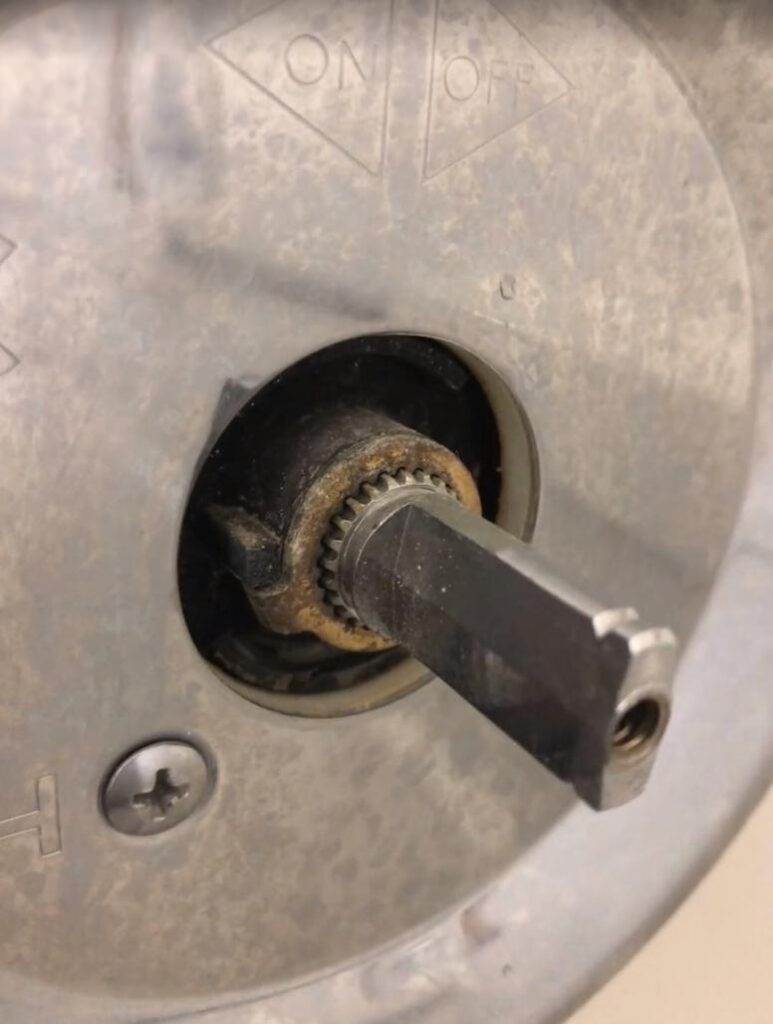
Single-handle valves came into recognition and became popular in the 1970s and 1980s, allowing users to conveniently control both water and temperature with just one lever.
To control the water flow, you need to move the handle up and down, while moving side to side controls the water temperature. This mechanism allows quick adjustments, making it easier to achieve the desired flow and temperature without having to move much.
How to identify?
To identify a single-handle valve, look for a faucet with just one lever and see if there’s a logo or brand name on the trim or the valve’s body.
When you remove the handle and look inside the faucet, you will either find a cartridge or ball valve, which are the main features of this single-handle valve.
Old Shower Valve Identification: Step-By-Step Guide
In this step-by-step guide, we will break down how you can identify older shower valves, from the 1950s to 1970s, with these easy-to-follow instructions.
Step 1: Remove the handle or stem
The first thing you have to do is remove the handle or stem.
First, close the water supply or the main water supply. Once the water supply is closed, you will need some tools like a Philips screwdriver, Allen wrenches, or a flathead to remove the screws.
Next, look for the screws which are often hidden behind the trim, or a decorative cap, and unscrew them. But in case you are unable to locate the screws or can’t see them, try prying off the handle with a flat-head screwdriver.
Once the handle is removed, closely look at the valve stem to identify its type. This step is important as it can help you determine the age and model type of the shower valve.
Step 2: Examine the valve body
Once the handle is being removed, the next step is to examine the valve’s body. It is usually hidden behind the wall or shower trim, look at it closely as it holds very important information about the maker’s logo, type, and what age it belongs to.
Look for laser markings, prints, model numbers, or any other information that can be found on the valve’s body. If you are unable to see the markings or the brand’s logo then you can just use the valve’s shape, design, and material to identify its type and what era it belongs to.
Older valve models were often made from materials like brass or copper. If this doesn’t help then you can take a picture and ask a hardware store near you.
You can also visit any hardware store to know the valve’s type and model.
Step 3: Check the type of shower Valve
By identifying the type of shower valve, you can easily determine its age and model. The first thing you should check is the number of handles and then see how the valve works.
After you have identified the type of shower valve, you will be able to find the right repair parts or replacements for it.
Depending on the number of handles, if you are dealing with single-handle valves, two-handle valves, or diverter valves, check the valve’s functioning and whether it needs multiple turns or just a few turns.
Step 4: Take measurements and photos
In the next step, by taking measurements and photos, you can use it to identify the old shower valve. First, measure the valve’s diameter and the distance between the handles, and count the number of spleens, many manufacturers tend to have different designs and numbers of spleens for their valve’s body.
Now take photos from multiple angles, make sure you capture any visible components like stamps, markings, logo, or model number in the photos. You can share these photos with professional plumber.
You can also use tools like Google Lens to help analyze the images and help you identify the valve models quickly.
Step 5: Take help from a professional
If you are still having trouble identifying the valve then it’s time to consult a professional plumber. Professionals can help identify the valve’s type and what era it belongs to.
You can also get guidance from these professionals on how to repair or replace the valve. You can find these plumbers by search on google. For example, searching “Jacksonville Shower Replacement” on google will help you find good plumbing companies.
Look at their reviews and ratings, and call them and share the images.
How To Use Old Shower Valve Identification Chart?
Identifying an old shower valve can seem challenging, but by observing it’s type on a shower valve identification chart, you can accurately match the right valve with its part number.
To get started, we’ll use this handy step-by-step on how to use this valve identification chart:
Step 1: Measure the Cartridge
First thing, grab your ruler or any other measuring instrument and measure that cartridge body. Place the ruler at the bottom of the cartridge and stretch it to the top where those grooves are.
If the measurement comes out to 2.5 inches, write it down. This is going to help us find a matching part.
Step 2: Check the Broach (Groove Pattern)
Now, let’s examine the top of the cartridge. You’ll notice a groove pattern that looks like a cross with 12 grooves. This pattern is called the “broach.”
The broach, or the groove pattern, located at the top of the cartridge, is a critical detail which will come in use when you match it in the chart.
Use page B-5 of the identification PDF to find the groove pattern chart.
Step 3: Match the Length and Pattern
After you have both the length and the groove pattern, find the cartridge in the chart that matches the information you noted.
The chart is organized by length and groove type, making it easier to find the exact match.
Now open the PDF, head over to page B-5, and find the broach chart. You’re going to look for cartridges that are around 2.5 inches in length and have the same 12-groove cross pattern. This chart will give you an exact match, so look very closely to those details.
Step 4: Write Down the Part Number
After you have found the perfect match, note down the part number. For example, if your 2.5-inch cartridge has a 12-groove broach, the part number may be 1234. Use this part number to order the correct replacement part.
With this guide in hand, you can now confidently identify your old shower valve and know exactly what part you’ll need to get it working like new again
Conclusion
It’s understandable that identifying old shower valves, especially those from the 1950s to the 1970s, can be quite confusing. But, by having proper shower valve identification guide, you will be able to find which type of shower valve you have.
By knowing the type of valve you have in your shower, it will be easier for you to troubleshoot problems like leaks, uneven water flow, random dripping, etc. The repairing and replacing process will be much smoother and hassle-free.
You can then find the maker’s name or logo on the valve’s body. But in some cases, if the valve is too old, it ends up getting rusty or damaged, making it unable to see the logo or any markings.
If you are unable to find the logo or brand’s name, then the best option would be to take photos of the valve and ask from your near by hardware store.